This nifty best seller called Influence was penned by Arizona State psychologist Robert Cialdini. When I purchased the book from Amazon my intention was to learn more about rhetoric and why people are persuaded by some arguments but not others (my interest in rhetoric started last year when reading this). In reading the book this question was somewhat answered ---indeed, language is important---yet, there were large amounts written about how people are persuaded by actions or social cues rather than words. Overall the book was fascinating and I learned a lot.
The book begins by pointing out that thinking is tough work. Because we don't like to strain our brain we often use "rules of thumb" or make decisions in an almost automatic fashion. There are several tactics that can be employed to take advantage of our mental shortcuts. And, while these tactics do not twist our arms into compliance the author's research points out that they are extremely persuasive. These tactics form the basis of the chapters in the book and Cialdini provides numerous examples of these tactics in several contexts. Note, he does not investigate how economic incentives persuade people to action, but, that's mainly because that fruit hangs too low on the tree.
Cialdini first presents the reciprocity principle. This principle is extremely powerful and pervasive. Upon reading the chapter I began to see many examples of this principle at work. Essentially, Person A would like Person B to do some action. In order to induce Person B to do that action Person A provides a gift to Person B. Then, person B will feel obligated to do that action. Real world examples exist in politics (think log rolling and campaign finance), business (free samples or week trials), and with charitable giving (St. Judes Hospital for example provided my wife and I with address labels). Specifically, with charitable giving Cialdini spoke of his observation of the Hare Krishna society and their approach of handing out flowers to a passerby and then asking for money. My own personal observations included an environmental sustainability group on campus that provided free cookies but also sought signatures for a petition. Also, I recalled in both Atlanta and Chicago that homeless people would offer directions to different destinations. Upon finishing directions they would ask for money. There are some subtleties to this reciprocity principle but Cialdini notes it is very powerful because we can sense the asymmetry and want to act to make the interaction more symmetric.
The second persuasive technique presented is called commitment. When people are on the fence they do not feel a strong affinity for one product/person/idea, etc. more than another. However, once people take sides there is a strong connection to the choice which shapes our perception of the choice as "good" or "bad". In other words, we become more certain of something immediately after we choose it. To be uncertain means we chose wrongly. This chapter is chalk full of examples of commitment from POW camps and communist indoctrination to romantic relationships, charitable donations, and promises of toys to our children. In a myriad of contexts the simple statement of "Yes," is meaningful and seems to commit us to a particular course of action. For example, I utilized the commitment technique a couple weeks ago at the laundry mat. Cialdini cites a study showing that people are far more vigilant in guarding other people's possessions when someone asks, "Will you watch my stuff?" whereas when this simple question is not asked people are highly unlikely to intervene if somebody tried to steal another person's possessions. The simple response, "Yes,", even to a small commitment opens up the door to larger commitments. This chapter was very interesting and I couldn't possibly discuss it all here in this summary.
The third persuasive technique is "social proof". Initially I thought, "What is social proof?"; however, it is pretty straightforward. Social proof simply says that we are likely to "see an action as more appropriate when others are doing it". This principle is especially true in uncertain or ambiguous situations. Should we laugh at that joke? What kind of clothing should we wear to that event? Basically, what is appropriate? This technique can be more severe. Cialdini utilizes social proof to explain the Jonestown deaths and the well publicized death of Katherine Genovese. When Jim Jones, leader of the People's Temple Cult, was certain to be under investigation for the murders of four people he called all of the believers to a mission of self-destruction: drink the strawberry poison. Cialdini reports, "The survivors claim that the great majority of the 910 people who died did so in an orderly, willful fashion." Why? Cialdini believes "social proof" helps clear up this mystery. Living in the strange country of Guyana (the cult had recently moved there from San Francisco) there was high uncertainty. Combine that uncertainty with some ultra compliant cult members and others followed suit. The Katherine Genovese story is one example in which many people witnessed a murder taking place but did not help. The common explanation was apathy amongst the citizenry (which I think could be quite valid). On the other hand, Cialdini notes that because nobody did anything everyone was uncertain about what to do. In uncertain situations we act based on the actions of those around us. I think more probable is that each person thought, "Someone else will call the police."
The fourth technique is immediately obvious: liking. We are persuaded to compliance by people we like. Moreover, we tend to like people who are attractive, people who flatter us, and people we view as being similar to ourselves. Cialdini discusses ways in which "liking" can be produced which include positive association. We have all heard the aphorism, "We are known by the company we keep" which was usually from our parents telling us about negative association. Cialdini writes, "As for positive associations, it is the compliance professionals that teach that lesson." Advertisers frequently use pretty girls or certain words that have nothing to do with their product but create a positive association. Anything to induce "liking".
Authority is the fifth technique which states that we are influenced by authority. The famous Milgram experiments are up close and personal in this regard (you can see a video about the Milgram experiments here). The Milgram experiments are one huge reason we have a Human Subjects Committee to protect people from research that can be psychologically harmful. But, they reveal something important: People respond to authority. We learn obedience to authority at an early age with parents, teachers, pastors, doctors, etc. guiding us or providing advice. Since they have been correct in the past we confer authority to the position. We should respect these types of people and Cialdini claims that we often carry out their requests in an unthinking fashion. Besides providing a plethora of examples Cialdini also notes that: Titles, Clothes, and Trappings all act as signals to people about how to value someone else even in situations where they would seem to have no special expertise. For example, Cialdini reported a psychological study that showed people were 3.5 times more likely to jay walk when a man with a suit crossed than when the same man crossed in ordinary dress. Another example, researchers in San Francisco found that people are far less likely to honk at luxury cars than economy cars when they are slow to pull away from a green light.
The final so-called "weapon of influence" is scarcity. Cialdini begins this chapter with a quote from G.K. Chesterton, "The way to love anything is to realize that it might be lost." When we are told we cannot have something (parental restriction, legal ban, etc.), or told "limited time only", or told to disregard certain information (jurors in a trial for example) our freedoms are being restricted. For example, star crossed lovers Romeo and Juliet may have had such heightened love because of the forbidden-ness of their courtship. Or, we want those things which seem scarce because we feel they must be of higher quality. If people generate a feeling of scarcity or restrict our choice set we are inclined to believe the thing we cannot have is a better choice. This has all kinds of implications for how we parent or what kinds of laws we make. To be honest, this is a difficult chapter that I am still digesting.
Now, I will close this review and reveal my nerdiness. These weapons of influence remind me of an exchange from Star Wars. Before Obi Wan and Luke leave Tatooine and team up with Han Solo they must bypass Storm Troopers searching for the lost droids.
Stormtrooper: Let me see your identification.
Obi-Wan: [with a small wave of his hand] You don't need to see his identification.
Stormtrooper: We don't need to see his identification.
Obi-Wan: These aren't the droids you're looking for.
Stormtrooper: These aren't the droids we're looking for.
Obi-Wan: He can go about his business.
Stormtrooper: You can go about your business.
Obi-Wan: Move along.
Stormtrooper: Move along... move along.
The weapons of influence are designed to elicit a "yes" response and work best when we are not paying attention. Cialdini closes each chapter with a section entitled "How to Say No". The key to saying "no" in most of these contexts is to understand why you feel compelled to say "yes". For example, the reciprocity principle illustrates that when we are given a gift we feel compelled to reciprocate. Yet, we must think about the purpose of the gift. Then, we may realize that it wasn't a "gift" at all. Or, in the case of authority we must ask whether they are a relevant authority or not. Also, we must ask whether they are acting out of their personal benefit. But, mainly the advice of these sections is simple: pay attention. Because people often function on a "click-whir" level we can be bypassed or conned like Storm Troopers. Our awareness is important.
There is no problem in studying compliance. However, this information can obviously be abused and utilized to manipulate people. In fact, because much of the discourse were studies motivated by real world examples these weapons of influence are already being used. When is it ethical to use such influencers (for example I think my use of the commitment principle was fine at the laundry mat)?
Mark and Doug are two Christian economists seeking to combine economics and theology in a fun, thoughtful, and inviting fashion. The name of the blog is a reference to Jesus' admonition to his disciples to be "wise as serpents and innocent as doves" (Matthew 10:16) when going forth into the world. We hope you join the conversation.
Monday, May 30, 2011
Sunday, May 29, 2011
Sunday Thought
A very good sermon from Rev. Bill Bess today. His central point was the following:
When Jesus says, in John 14:15
"If you love me, you will keep my commandments."
It is not a directive, it is a promise.
Saturday, May 28, 2011
William Parker and the LAPD, Part I
So how corrupt was the LAPD in the 20s, 30s, and 40s? Let's look at some popular culture references.
In the movie Changeling, one [in fact, two] courageous pastors use a religious radio broadcasts to expose the LAPD incarcerating in a mental hospital an "inconvenient" woman who was making charges against the department. Numerous accounts that Doug and I accessed confirm that the basic underlying story is TRUE.
In the novels of Raymond Chandler, the LAPD of the late '30s and early 40's is depicted as a mixture of some good cops and some that are lazy, incompetent, and on the take from various corrupt activities. In fact, more than one of the historical accounts claim that the LAPD of the period was, if anything, worse than Chandler depicted (certainly worse than the version depicted in the movies made from his novels). In the late 1930's, a crusading group of civic reformers, again with strong ties to local religious leaders, gained power on the county grand jury and began exposing civic corruption. The local news media, especially the vibrant competition between the Times and the Examiner, kept the story before the public. Representatives of the reform group were subject to violent attacks. Eventually, Mayor Shaw was recalled and his brother indicted over a scheme to sell police and fire commissions. (The, um, checkered history of the LA County District Attorney is another movie waiting to be made. ) The recall of Shaw installed reform-minded Fletcher Bowron.
The movie L A Confidential (based on the novel by James Ellroy) shifts in time some important events that occurred in the 1940s while Bowron was mayor. The police, under new leadership, put intense pressure on leaders of organized crime to leave Los Angeles. Many left for Las Vegas. Mickey Cohen was indeed the face of the mob to most citizens of Los Angeles. But, in 1949, the news broke that a prostitution ring was being run with assistance from inside the LAPD. As far as we could tell, LAC's depiction of the plastic surgery to create prostitutes who resembled famous movie stars is fiction, but the Brenda Allen prostitution scandal and other concurrently revealed events were the reason that the LAPD needed a new police chief, and with a one vote majority on the Police Commission, that chief was William Parker.
Finally, here are the answers to our previous questions about famous fictional photos. Parker helped to make the honest, tough, hard working officer Joe Friday of "Dragnet" the face of the LAPD. At some point, Parker needed some help writing speeches, and the job went to an officer with writing talents named Gene Roddenberry. Two of our sources state that Roddenberry modeled the character Spock after his former boss, William Parker. And while the movie L A Confidential has a new, reform minded chief in the script, many of the personal characteristics of Ed Exley suggest the younger William Parker (right down to the glasses).
One of our best sources for the paper is the history L A Noir by John Buntin. And if you want to see how Joe Friday became a cultural icon, this clip is not to be missed.
Friday, May 27, 2011
Friday Links 5/27
Like the Florida ground my blogging activities have run into a dry spell; however, like the Florida weather, the forecast is looking much better. In the next couple of weeks I should have a blog post regarding minimum wage v. the earned income tax credit as well as a few book reviews and some other misc. material. For now, the Friday Links should suffice.
On May 19th one of my favorite blogs, Aid Watch, penned its swan song. The posts were frequently insightful, sometimes sarcastic, but most of all, they were never dull. The blog achieved its objective of bringing more attention to the economics of development and whether our various attempts to help those in less developed countries really worked. For interested people, the search function on the blog will allow you to cull the archives for some very thoughtful material.
An article about an economist, Tyler Cowen, who writes for another one of my favorite blogs Marginal Revolution. He's very interesting, just read it.
This article appeared in the Boston Globe some time ago; however, I just discovered it. This article makes me proud that economists can help solve such problems as matching medical residents to residencies, children to particular schools, or kidneys to in-need medical patients. However, the crown of "society's mechanics" is not one we should bear without a nod to humility and our own limitations. (Also, the article mentions FSU professor David Cooper)
Friday, May 20, 2011
The Reform of Corruption: The Case of the LAPD


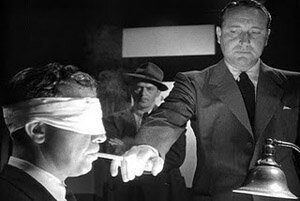
In the 1930, Los Angeles was an extraordinarily corrupt city. A columnist in TIME referred to the city as the slobbering civic idiot of American municipalities. Police and fire commissions were being sold. Author Raymond Chandler artfully depicted a police force riddled with sloth and bribery, only slightly less bad than the hideous "Bay City" police in his Philip Marlowe novels. A serious reform movement in the late 1930s seemed to bring things under control, then just as TIME appeared to revise its view of LA in 1949, a scandal involving a prostitution ring operating inside of the LAPD threatened to revive the image of the LAPD of Raymond Chandler. (The picture above is a depiction of an LAPD interrogation in the movie Murder My Sweet appearing on the website piddleville.com)
In this sordid environment, the Los Angeles Police Commission appointed William H. Parker as it's Chief. And something remarkable happened. Within a handful of years, Parker had cleaned up the LAPD, so that by the mid 1950s it was being looked to as a model of police professionalism. The picture above right is Parker, as taken from the official LAPD website.
How did this happen? How was Parker able to steward such a remarkable and rapid turnaround? What are the implications for the elimination of corruption in the developing world. Doug and I have a new paper: "Just the Facts Ma'Am: A case Study of the Reversal of Corruption in the Los Angeles Police Department," looking at these questions.
Background reading is tedious, but background watching can be fun. So the question is: what do these fictional characters have in common? (Sgt. Friday is from the official LAPD website, Mr. Spock is from Wikipedia, Ed Exley is from this review of L.A. Confidential in Slate.com.)
Friday Links May 20, 2011
Social norms: voluntary or enforced. Do private norms drive the de jure rules, or do we need the de jure rules to support private norms? (NRO)
For no particular reason: original names of famous bands. (Debby Witt on NRO).
A book I must read this summer: Bonhoeffer: Pastor, Martyr, Prophet, Spy by Eric Metaxas.
While I'm at it: Bonhoeffer and Tobacco.
Thursday, May 19, 2011
Randomized Controlled Trials Part II: The Scientific Method
Remember the science projects of your childhood? Thinking about wielding the bi-fold boards onto the kitchen table, cutting colored paper, and pasting the various hypotheses, data, and results make me nostalgic. This trip down memory lane occurs whenever I consider the scientific method because these memories are familiar. My science fair projects were never anything special; however, even now they seem illustrative. For example, do plants grow better in the presence of classical music, rock music, or no music? So, my dependent variable was plant growth. The plants were identical in every respect. Same bag of seeds. Same soil. Same sunlight. Same watering. The only difference was the exposure to different music. My control group was "no music". My treatment groups were "rock music" and "classical music". Perhaps the question was juvenile and the sample size small, but, when you think about it, this is the scientific method at its best.
For a moment, consider a question that personally interests you. Will school uniforms improve educational outcomes? Does religious proscription improve generosity? Does merit-based teacher pay improve student educational outcomes? What will the impact of a different tax structure do to labor supply? What is the impact of job training programs on ex-convicts? Does marriage make people happier? And, the list could go on, and on, and on.
The scientific gold standard is a "randomized controlled trial" with a large sample size. The term "randomized controlled trial" is borrowed from the medical and clinical fields and is quite descriptive. Randomization matters because it reduces self-selection bias.
Randomization can help overcome the selection bias. Randomization would assign people into job training programs and thus weed out any underlying differences between the two sets of populations (those who would sign up and those who would not sign up).
Controlled implies that the only difference on average between people in the sample will be whether or not they received job training. Like my flowers example where the only difference was exposure to different music, the only difference, on average, among those being released from jail was whether they received job training or not. Certainly there will still be differences between people released who receive job training and those who do not; however, those differences will be balanced.
Obviously there are some questions that cannot be answered by randomized controlled trials. For example, the Human Subjects Committee wouldn't allow me to randomly assign people to religions in order to observe how certain religious teachings alter generosity. Also, they would likely disallow random assignment of people into marriages to figure out whether marriage causes them to become happier. These are good things! But, there are a number of really interesting questions that can be answered with randomized controlled trials. In my next post I will discuss some of the interesting "field experiments" (equivalent term for RCT) that have been conducted in the past and more recently.
By the way, the plants grew better under classical music. Though this is far from an iron-clad empirical reality.
For a moment, consider a question that personally interests you. Will school uniforms improve educational outcomes? Does religious proscription improve generosity? Does merit-based teacher pay improve student educational outcomes? What will the impact of a different tax structure do to labor supply? What is the impact of job training programs on ex-convicts? Does marriage make people happier? And, the list could go on, and on, and on.
The scientific gold standard is a "randomized controlled trial" with a large sample size. The term "randomized controlled trial" is borrowed from the medical and clinical fields and is quite descriptive. Randomization matters because it reduces self-selection bias.
For example, imagine that we were studying the impact of a government sponsored job training programs for ex-convicts. The before-and-after study may show tremendous success in transitioning ex-convicts into the workforce; however, substantial information would be missing. If the job training program is voluntary there could be differences in motivation, education, etc. amongst some of the ex-convicts compared to their counterparts that did not sign up. Therefore, the question would be, "How much is the job training helping, or, would these people have found work regardless of the program simply because they are highly motivated to turn their life around?"
Randomization can help overcome the selection bias. Randomization would assign people into job training programs and thus weed out any underlying differences between the two sets of populations (those who would sign up and those who would not sign up).
Controlled implies that the only difference on average between people in the sample will be whether or not they received job training. Like my flowers example where the only difference was exposure to different music, the only difference, on average, among those being released from jail was whether they received job training or not. Certainly there will still be differences between people released who receive job training and those who do not; however, those differences will be balanced.
Obviously there are some questions that cannot be answered by randomized controlled trials. For example, the Human Subjects Committee wouldn't allow me to randomly assign people to religions in order to observe how certain religious teachings alter generosity. Also, they would likely disallow random assignment of people into marriages to figure out whether marriage causes them to become happier. These are good things! But, there are a number of really interesting questions that can be answered with randomized controlled trials. In my next post I will discuss some of the interesting "field experiments" (equivalent term for RCT) that have been conducted in the past and more recently.
By the way, the plants grew better under classical music. Though this is far from an iron-clad empirical reality.
Subscribe to:
Posts (Atom)