A simple "Yes" or "No" will do.
So:
Yes!!
Will. Somebody. Please. Show. Me. How. To. Block. The. Google. Soccer. Doodles.
Cannot. Take. This. Anymore.
Wednesday, June 25, 2014


Tuesday, June 24, 2014
Rise of the Humans
According to a Wall Street Journal article today on Page C3 ("London Hangs on to Ring" by Laura Clarke), the London Metal Exchange has decided to keep its face-to-face open outcry market process. This is in an era in which computerized trading has replaced face-to-face open outcry systems in a number of exchanges. I really liked the comment of Robin Bahr:
"I think it's a very efficient price-discovery process.....There's a feeling that it's transparent, people can see it. You get a good feel for how trading is taking place because your traders are facing each other on the floor."
Sounds like a dissertation topic for a student in experimental economics.
Friday, April 11, 2014
Orthodoxy and the University
You may have heard of Ayaan Hirsi Ali. She is a activist with strong views about the role of women in Islamic societies. She was to be honored with an honorary degree at Brandeis University, a university known for being unafraid to honor people with unpopular views. In Ms. Ali's case, however, Brandeis backed down in the face of criticism of (we are being told ) students and faculty. Brandeis cancelled Ms. Ali's honorary degree. Today, in the Wall Street Journal she published "Here's What I Would Have Said at Brandeis." I do not want to debate here, or even put out for debate here, the underlying issues that were swirling around Ms. Ali and her personal history. What I do want to do is to reproduce from her article a quote about the role of open inquiry at a university:
"When there is injustice, we need to speak out, not simply with condemnation, but with concrete actions.
One of the best places to do that is in our institutions of higher learning. We need to make our universities temples not of dogmatic orthodoxy, but of truly critical thinking, where all ideas are welcome and where civil debate is encouraged. I'm used to being shouted down on campuses, so I am grateful for the opportunity to address you today. I do not expect all of you to agree with me, but I very much appreciate your willingness to listen."
Thursday, March 27, 2014
School Vouchers
Here is a brief and recent video from Reason TV on a family's story related to the D.C. voucher program. At one point in the video a family member says, "[Education] should not be political". Unfortunately it has been made a political issue. Watch documentaries The Lottery or Waiting for Superman (and follow one of the protagonists from The Lottery Eva Moskowitz in her attempt to save the Harlem Children's Success Academy from Mayor De Blasio) . These documentaries make compelling cases for school choice. When people have the capability to choose their school they're capable of "voting with their feet" which rewards good schools and brings discipline to bad schools. Of course there are arguments against vouchers and school choice (we might explore some of those in a future post) and not all charter schools or private schools are equally good. But, even if someone chooses a bad school there is still the chance to switch, that choice is not available for a child attending a bad public school.
Thursday, February 13, 2014
Analytic Narratives
In a few days I will drive to Washington DC to be a visiting dissertation fellow at the Mercatus Center. While there I will attend and participate in lectures with faculty members at George Mason. In particular I am excited to hear lectures from Mark Koyama in his course on "Analytic Narratives". An analytic narrative is an approach to economics that combines some of the theoretical and statistical tools in economics (e.g. game theory and econometrics) with a more historical or ethnographic narrative.
I have started reading for the class. The first lecture is on the "Persistence of Cultural Beliefs" and the first paper I have read is titled "Fertility and the Plough" which is a working paper (here).
It has often been argued that once upon a time fertility was higher because children were not liabilities but assets. Put another way, agriculture is labor intensive and children were valuable because they could be put to work. But, even among agricultural economies there were differences in fertility rates. What could explain the variation in fertility? These authors argue the plough.
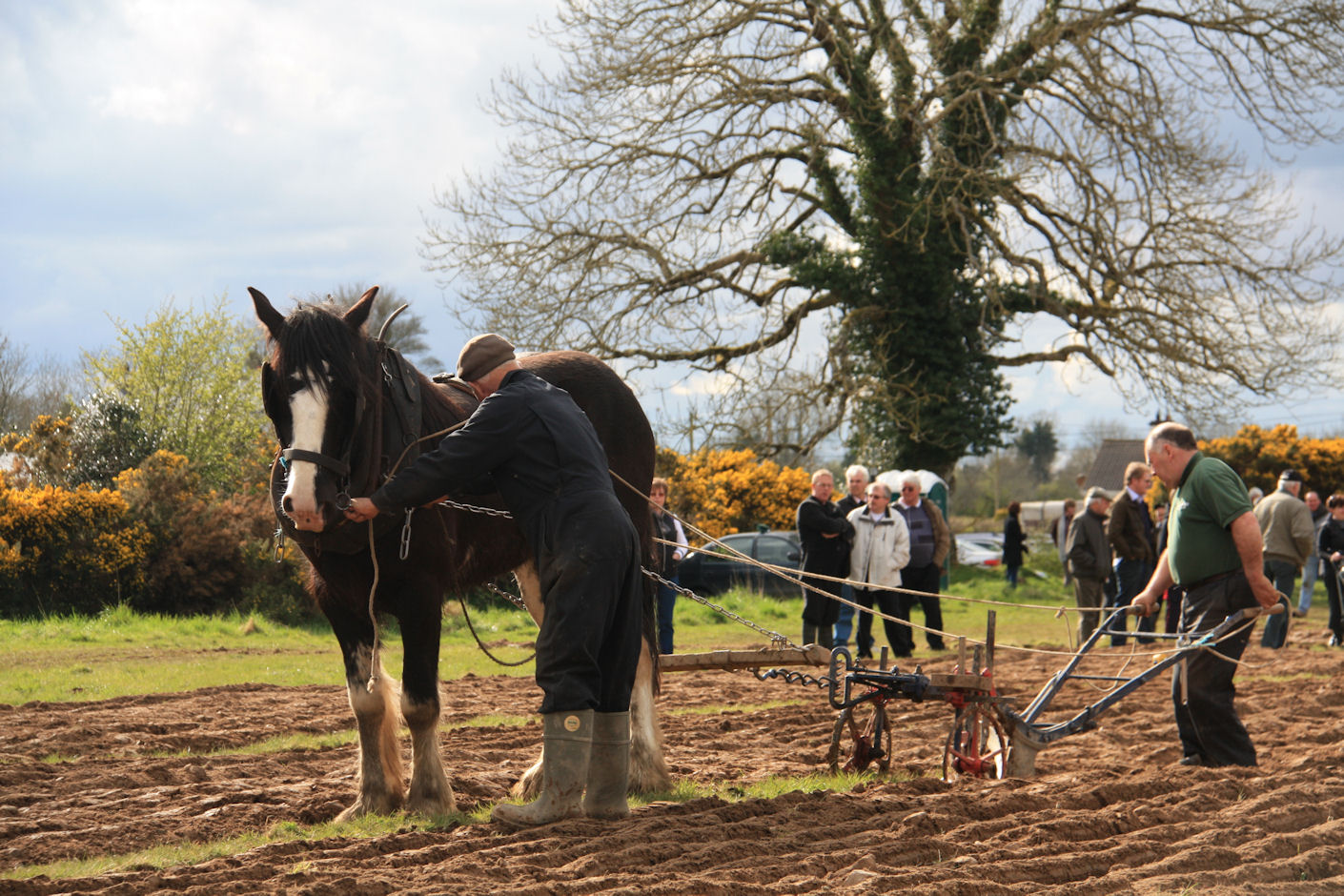
The argument is that agriculture broke down into two camps: hoe or plough. When farming with a hoe children were important to weed the soil before the hoe was utilized. However, with a plough weeding wasn't important, the plough would tear up all the weeds. The use of the plough also meant that women were not much use in agriculture (like children they would weed) since the plough required more strength.
One might think that women being in the home and not working in the fields would lead to a lower cost for women having children. On the margin, this means fertility would be higher. However, the authors show that this is apparently more than offset by the lower benefit to having children.
Furthermore, the authors show that controlling for a lot of other factors that could also impact fertility like economic development. Then the authors show that there is an impact on fertility outcomes in PRESENT TIMES that can be tied back to the plough. To show this cultural transmission the authors rely on first and second generation immigrants to the United States. The argument being that, immigrants have their cultural heritage but operate in a well developed economy. First generation immigrants show more of the cultural attribute than second generation. This is the reason the paper falls under "Persistence of Cultural Beliefs".
The one glaring weakness in their paper is that the authors do not seem to control for religious beliefs that would seem to have some influence on people's perspective about children. Perhaps, this is no problem because there was homogeneity in religious beliefs about children. Nevertheless, it was worthy of at least a footnote.
I have started reading for the class. The first lecture is on the "Persistence of Cultural Beliefs" and the first paper I have read is titled "Fertility and the Plough" which is a working paper (here).
It has often been argued that once upon a time fertility was higher because children were not liabilities but assets. Put another way, agriculture is labor intensive and children were valuable because they could be put to work. But, even among agricultural economies there were differences in fertility rates. What could explain the variation in fertility? These authors argue the plough.
The argument is that agriculture broke down into two camps: hoe or plough. When farming with a hoe children were important to weed the soil before the hoe was utilized. However, with a plough weeding wasn't important, the plough would tear up all the weeds. The use of the plough also meant that women were not much use in agriculture (like children they would weed) since the plough required more strength.
One might think that women being in the home and not working in the fields would lead to a lower cost for women having children. On the margin, this means fertility would be higher. However, the authors show that this is apparently more than offset by the lower benefit to having children.
Furthermore, the authors show that controlling for a lot of other factors that could also impact fertility like economic development. Then the authors show that there is an impact on fertility outcomes in PRESENT TIMES that can be tied back to the plough. To show this cultural transmission the authors rely on first and second generation immigrants to the United States. The argument being that, immigrants have their cultural heritage but operate in a well developed economy. First generation immigrants show more of the cultural attribute than second generation. This is the reason the paper falls under "Persistence of Cultural Beliefs".
The one glaring weakness in their paper is that the authors do not seem to control for religious beliefs that would seem to have some influence on people's perspective about children. Perhaps, this is no problem because there was homogeneity in religious beliefs about children. Nevertheless, it was worthy of at least a footnote.
Thursday, January 30, 2014
An Inconvenient Pedestrian
The City of Tallahassee is spending a large amount of money building a new network of sidewalks to make Tallahassee more "pedestrian friendly." One of these sidewalks goes along Seventh Avenue. The sidewalk is not finished due to several very dangerous construction holes around storm drains. There are numerous barriers telling pedestrians that the sidewalk is still officially closed. Today, as I was getting ready to turn onto Seventh Avenue, a pedestrian, who should not have been there in the first place, and gabbing away on his cell phone, stepped directly in front of my car just before I hit the gas pedal.
So, City of Tallahassee safety planners, have you considered the possibility that
Better Sidewalks MEAN More Aggressive and Less Attentive Pedestrians WHICH MEANS More (Not Fewer) Pedestrian Deaths and Injuries?
Let's hope there isn't a Ph.D. dissertation in someone's future on this proving another example of good intentions having tragic unintended consequences.
So, City of Tallahassee safety planners, have you considered the possibility that
Better Sidewalks MEAN More Aggressive and Less Attentive Pedestrians WHICH MEANS More (Not Fewer) Pedestrian Deaths and Injuries?
Let's hope there isn't a Ph.D. dissertation in someone's future on this proving another example of good intentions having tragic unintended consequences.
Data. Data. Data.
"Data. Data. Data." he cried impatiently. "I can't make bricks without clay." ----Sherlock Holmes in "The Adventure of the Copper Beeches," as quoted in Wikiquote.
In today's round-up of FSU researchers in the news, there is a link to an article in MedicalXpress. It seems that two FSU statisticians have been crunching numbers on breast-cancer patients' genetic markers and which cancer therapies they received, and have found, in preliminary data analysis, that if the patients' cancer treatments "had been tailored to the patient, the response rate would have risen from 21 percent to 39 percent." That 18 percentage point increase is an 85% increase over the baseline of 21 percent. That is huge.
Interestingly, the two FSU researchers, Jinfeng Zhang and Kaixian Yu, are not physicians. They are statisticians.
Take-away quote from Kathleen Haughney, author of the article:
"Doctors [i.e. physicians], though trained to diagnose and treat, are not statisticians."
In today's round-up of FSU researchers in the news, there is a link to an article in MedicalXpress. It seems that two FSU statisticians have been crunching numbers on breast-cancer patients' genetic markers and which cancer therapies they received, and have found, in preliminary data analysis, that if the patients' cancer treatments "had been tailored to the patient, the response rate would have risen from 21 percent to 39 percent." That 18 percentage point increase is an 85% increase over the baseline of 21 percent. That is huge.
Interestingly, the two FSU researchers, Jinfeng Zhang and Kaixian Yu, are not physicians. They are statisticians.
Take-away quote from Kathleen Haughney, author of the article:
"Doctors [i.e. physicians], though trained to diagnose and treat, are not statisticians."
Subscribe to:
Posts (Atom)