Monday, June 14, 2010

The Evolution of Free Enterprise Values

This article attempted to tackle the question of cultural transmission. That is, how cultural/social norms (such as driving on a certain side of the road, appropriate dress for the occasion, opening the door for women, etc).  stick or fade away.  In fact, when we purchased coffee at Starbucks before the start of the readings group for the article I came face-to-face with a social norm in our culture: women shave their legs. (This revealed something interesting about social norms, that is, you don't notice them until they're violated.)

But, the larger question is not about shaved legs and manners. Instead, the authors try to solve a giant macro-evolutionary puzzle: Markets are known for their success in adaptation (because they allow people to freely choose they adapt quickly to preferences in the population), but, why was cultural evolution over the last 50,000 years slow when markets allow for adaptation? The authors were not very successful at answering their question. Ultimately the article amounts to small patchworks of ideas from different disciplines hastily sewn together in a fashion that leaves the reader searching for more substance.

There are two caveats for why this sharp critique could be made more conservative. One, the field is new.  "We [the sub-field of cultural anthropology] are still near the beginning of this explanatory endeavor, but we know roughly what dots we need to connect and have the means to draw some interesting hypothetical dashed lines between them". Two, they may have been able to reach greater depth in a full length book.


The authors present a myriad of ideas about the transmission of these norms of cooperation that underpin the market economy.These theories about the several forces that simultaneously move to change culture are listed in three categories below:

  1. The Adaptive Advantage of Culture - Humans adapted complex culture prior to other animals and this culture evolved rapidly -too quick for natural selection to have occurred. Once the advanced culture is established other species could not evolve since we house the ecological niches necessary for complex culture.  
  2. Tribal Human Nature, Work-Arounds, and Organizational Management - These ideas amount to what economists would call "Tiebout Competition" and compromise (not a fancy economics word). In tribal human nature people select into tribes that hold attributes that a prospective member believes. When a tribe has attributes that resonate with most people there is an inertia to following the rules of the tribe. But, tribes had inter-tribal warfare. How did we adopt a free market culture based on cooperation and mutually beneficial exchange? We constructed "work-arounds" or compromises between all of the various tribes (consumers, suppliers, producers, etc.) held together by good organizational skills.
  3. The Moral Hidden Hand and the Functioning of Organizations - Humans possess empathy -or- the ability to place ourselves in another person's situation. There is significant evidence to suggest that people operate out of this empathy and that will produce a "spontaneous [moral] order" (by the way, of their extensive reference list they do not talk about Hayek). This moral order plays directly into the ability to cultivate free enterprise.


Quick question. How are these theories falsifiable? That is, how would one select the theory that most appropriately defines cultural transmission in the last 50,000 years? Or, is each correct given certain circumstances? Cultural transmission is an interesting question, but, these are pretty large unanswered questions.Also, the authors offer a number of theories for what speeds or slows the tempo of cultural transmission (geography, disease, new technology, climate, human biology, ideology, etc.). Between these two categories there are enough theories to play a baseball team! 


Ultimately, the author's side with their theory of the moral hidden hand and conclude,"The free enterprise societies' combination of individual autonomy, wealth, and welfare bear a strong resemblance to the preferences that are rooted in our ancient and tribal social instincts." Moreover, they keep with the theme of Moral Markets that our market economy is not primarily based on selfishness but contains a strong component of empathy. Because the market exists in a social setting, and human beings are social creatures,  we act in a market environment with cooperative tendencies.

In the end, I think the following statement the authors make is why this article was so disappointing, "Do we have a serious macroevolutionary flaw in the cultural evoluntary explanation? We think the answer is that we do have plenty of macroevolutionary puzzles to solve but that we also have plenty of candidate hypotheses to explain the fifty millenia." Again, which candidates are best? How will you test them?

Wednesday, June 9, 2010

Unintended Consequences #7

How is it possible for a reporter for a major business news concern (CNBC) to compose an on-line article entitled "Teens Face Worst Summer Job Market in 41 Years" and never mention the recent increases in the minimum wage? Unbelievable.

Tuesday, June 8, 2010

The Usual Suspects

Doug and I have discussed below the question of when do we (either as economists or as non-economists interested in policy issues) "know" something based upon economic research. One finding that I have observed to be robust in several different economic analyses is that Wal-Mart provides consumers with lower prices, especially to lower income shoppers. A nicely done example of such research can be found here.* Not surprisingly, the range of estimations of the price effect varies somewhat; numbers that I recall fall into the 3% - 10% range.

Let's suppose we remained unconvinced of the validity of the proposition that Wal-Mart stores lead to lower prices, and wanted to find evidence outside the realm of the statistical analysis of applied econometrics. If Wal-Mart stores drive down customer prices, then an obvious category of "losers" from the arrival of a Wal-Mart would be the region's existing retailers. Evidence that existing retailers expended resources to block the arrival of a Wal-Mart would be independent evidence of a) existing retailers' expectations that they will be hurt by Wal-Mart, and b) ongoing oligopoly rents by the existing retailers; otherwise they would not be able to divert resources to a rent-seeking activity such as blocking rivals. The latter statement is separately interesting from the first, because if the existing firms are earning zero-economic profits given their technological possibilities, they are more likely to exit the market with a significant entry by Wal-Mart. On the other hand, if the existing firms are earning monopoly or oligopoly rents, then they may survive after a Wal-Mart entry, but with lower prices and profits. Some evidence on this is discussed in the Basker paper I linked above.

Now comes the news section (as opposed to the editorial pages) of the Wall Street Journal, yesterday, in a Page 1 story "Rival Chains Secretly Fund Opposition to Wal-Mart," by Ann Zimmerman (I won't link to the story because WSJ articles disappear after a few days). Reporter Zimmerman profiles the Saint Consulting Group, whose founder calls his staff "Wal-Mart killers." Saint is often active in assisting "local" political attempts [land use fights are very common] to block entry by Wal-Mart. Zimmerman reveals two points: the most important being that these anti-Wal-Mart campaigns are often paid for by ... (drum-roll please) the existing retailers who don't want Wal-Mart as a competitor. Zimmerman details funding by Safeway, Giant Foods, and Supervalu (Jewel-Osco). For example "Supervalu's objective was to block Wal-Mart from competing with its nine Jewel-Osco supermarkets located within three to ten miles of the proposed [Wal-Mart] shopping center."

(A second revelation was that much of the activity promoted by these anti-Wal-Mart protests is "astro-turfing" : outside consultants using phony names and false rumors. I won't spend a lot of time on this aspect of the article because to paraphrase Captain Renault in Casablanca, "I am shocked, shocked to find that some of the rumors about Wal-Mart are not correct.")

So we have direct evidence that confirms the statistical econometrics results. Existing grocery firms who are already capturing some kind of supra-competitive economic profits can and do divert some of those profits to political campaigns to block a competitor which threatens to compete away those profits.

I am constantly amazed by the hostility towards Wal-Mart by people whose political and/or religious convictions are to "help the poor" when there is so-much evidence that Wal-Mart's lower prices do just that. (Disclosure, I have lived in a small Oklahoma town that I heard later obtained a Wal-Mart, so I know something about the kinds of towns that made Sam Walton both rich and famous). I sometimes think that perhaps anti-Wal-Mart sentiment represents an instinct to attack the rich, even if that means hurting the poor. There are two problems with having such a philosophy. First, that bias would seem to me to be a type of injustice that is itself forbidden by Scriptures. Secondly, who believes that Safeway, Giant Foods (owned by a Dutch firm), or Jewel-Osco represent poor "local" retailers?

Monday, June 7, 2010

Charter Cities (it's all about the rules)

Besides the scenery and other small novelties, educational podcasts are one of my favorite pastimes on long car rides. After dropping my wife off at the airport in Orlando I popped in Econtalk (probably my favorite podcast) and listened to Paul Romer and Russ Roberts discuss "Charter Cities". I'd stumbled upon Charter Cities before, via a summary of Romer's presentation at a TED Conference (video here and pictured below), but, the podcast helped to more clearly define the nature of a charter city and why Romer believes they wield untapped potential for economic development.


What are charter cities? According to the FAQ on Romer's project website (www.chartercities.org) the basis for a charter city are, ". . . uninhabited land and a charter granted and enforced by an existing government or collection of governments. With the right rules, a city will naturally grow as residents arrive, employers start firms, and investors build infrastructure and buildings."  The notion of settling uninhabited land with a brief set of rules is not beyond the scope of history. William Penn settled Pennsylvania with a small set of rules, chief among them freedom of religion. The following is from the Pennsylvania Charter of Privileges,

BECAUSE no People can be truly happy, though under the greatest Enjoyment of Civil Liberties, if abridged of the Freedom of their Consciences, as to their Religious Profession and Worship: . . . I do hereby grant and declare, That no Person or Persons, inhabiting in this Province or Territories, who shall confess and acknowledge One almighty God, the Creator, Upholder and Ruler of the World; and profess him or themselves obliged to live quietly under the Civil Government, shall be in any Case molested or prejudiced, in his or their Person or Estate, because of his or their conscientious Persuasion or Practice, nor be compelled to frequent or maintain any religious Worship, Place or Ministry, contrary to his or their Mind, or to do or suffer any other Act or Thing, contrary to their religious Persuasion . . .

Again, the set of rules does not need to be complex but perhaps based on a couple of key principles. We will come back to the civil liberties in a moment, but in the TED video Romer identifies Hong Kong as a proxy charter city (more to do with their economic rules). Although Hong Kong was located in China it operated, with stunning success, under British rules for much of the 20th century.Seeing the success of Hong Kong, China established more "special economic zones" (SEZ) or "open cities". These zones have been very successful at attracting foreign direct investment. Further testimony to the success of some simple economic rules are how other countires have applied the blueprint of these business zones. Such countries include India, Brazil, Pakistan, and several others. With more favorable rules toward businesses significant growth has been attributed to these SEZ.


Before we talk about what kinds of rules help spur growth some background knowledge about Paul Romer might be important. How did Romer, a man that graduated with his PhD from Chicago, and an imminent macroeconomic scholar, suddenly find a new research agenda that looks at the adoption of rules? The short answer? Rules, how they are selected and discarded (as well as their more subtle evolution) turned out to be the burning unanswered question about progress. Technologies (the topic for which Romer earned his reputation) do not matter if the legal rules and social norms to facilitate trade and the exchange of ideas are not in place.(By the way, we care about growth because we care about the standard of living in these poor countries)


What helps the exchange of ideas? Free elections, freedom of speech, freedom of religion, etc. These all fall under the category of "civil liberties". Probably the most frequently used index to rate the vitality of civil liberties in a country is the Freedom House Index. These are rules that help facilitate the transmission of voter preferences through the political process and help to create an open space for ideas to be heard.   


What helps to facilitate trade? Security and Incentive. The economic environment must be secure to promote trade ---uncertainty scares investors away. And uncertainty can come through many channels: the court system and the macroeconomic environment. A sound legal system is needed to secure property rights (property could be on land, ideas, anything that belongs to you). Also, courts help enforce contracts which provides peace of mind in large business deals. Moreover, uncertainty can take place with respect to the macroeconomic environment with the devaluation of currency and poor access to money. The second part of  what helps to facilitate trade deals with incentives. How much of the benefits of trade does a person get to keep? That is, how much must they give to governments either via a trade barrier such as tariffs or in income tax? These can reduce the incentive for businesses to trade. Probably a good follow up to this discussion would be to glance at the Economic Freedom of the World Index.  


This discussion of the kinds of rules that facilitate trade and exchange of ideas have a common theme: freedom. Interestingly, Romer says that Charter Cities are all about choice. We want to allow people to enter/exit a city. And, with good rules this charter city will attract business, jobs, and people. Romer believes that a Charter City is more effective than a village and more politically palatable than changing a whole nation. Remember that whenever a rule changes there are usually winners and losers. That means that changing the rules on a national scale would likely invite fierce opposition. Romer believes a city is just the right size.


Finally, upon writing this blog post I became aware of two very good interviews. One of the interviews took place last year on the Aid Watch blog and another Q&;A with Romer on the Freakonomics Blog. There will certainly be more Q&A's in the future since there are so many unanswered questions and charter cities are a provocative idea, perhaps the best on a menu of otherwise undesirable and expensive development practices.

Friday, June 4, 2010

Monkey Business

This is a summary of a pair of articles titled "How Selfish an Animal?" by Frans de Waal and "Fairness and Other-Regarding Preferences in Nonhuman Primates" by Susan Brosnan in the book Moral Markets. Both articles are from evolutionary biologists studying chimpanzees and other species and how they respond in social situations. The article by Frans de Waal is concerned with the exchange of favors by chimpanzees while Brosnan is concerned with how chimpanzees divide the distribution of rewards. Both of these authors believe that the study of animals have implications for human biological foundations which they believe have implications for how we establish social/legal rules.

The main contribution of Frans de Waal from this article is to separate selfish from other-regarding behavior by saying that they are two levels of explanations. There are ultimate causes and proximate causes of behavior. For example, he believes that we likely developed other regarding behaviors ranging from reciprocity to altruism because the earliest animals lived and hunted in community. Because these behaviors were necessary for survival we could say their ultimate cause was selfishness via self preservation. However, behavior could be more proximate which means that the motivation may not stem from selfish long run tendencies, but, a desire to do good for others. (Side Note: Perhaps I inflate the importance of this distinction, but, in economics many people distill all behavior down to self-serving tendencies. I believe self-interest is a strong tendency but I also believe that there are many times that other motivations are the source of action

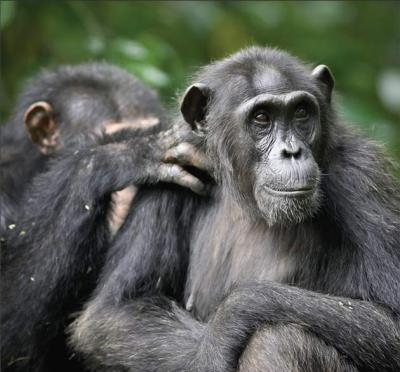
After that distinction de Waal is primarily concerned with cooperation among chimpanzees with a whole host of reciprocal behaviors dubbed “the marketplace for services” that includes grooming, sex, support in fights and baby sitting. Though these are reciprocal acts (where favors are given with the expectation of return) de Waal advises the reader not to see them as self-serving (a la the previous paragraph). The key findings from de Waal surrounding these reciprocal behaviors rests in the group dynamics. When chimpanzees operate in groups they are successful to the extent they are able to reciprocate. If reciprocal acts do not occur revenge may be taken upon free-riders in the group. More commonly the disenchanted group members form new groups with whom they can cooperate.

Below is a video of de Waal explaining his interests in studying chimpanzees.


Susan Brosnan shares a similar interest with de Waal since she studies chimpanzees in community, but, focuses more on how the chimpanzees distribute rewards. Her central finding is that there are multiple levels in why some division is considered fair by chimpanzees. The distribution matters BUT it matters less if attainment of the initial prize is considered fair by the other participants. Wow! That sounds a lot like why people dislike the market economy sometimes. If you believe success is based more on luck that skill you will want a more fair distribution. However, if you believe someone obtained a prize based on skill the distribution will matter less. Brosnan also talks at length about studies that have found aversion to inequalitiy or inequity as well as the propensity of people to engage in social comparison.

They say there are at least two benefits to studying chimpanzees ---the study is purely positive and they are free of formal institutions. What do I mean by positive? One problem with studying how humans make cooperative decisions is the moral component. Essentially we cooperate because we believe we should cooperate. Chimps don’t have this moral component hence we are not getting moral obligation when we see their behavior. Secondly, they do not have formal court systems, contracts, etc. Of course, they do have other arrangements that involve revolt and protection in fights. But, both of these “benefits” arise because chimps do not have the same higher cognitive ability. Finally, I will close with my feeling about the article.

In the introduction to her chapter Brosnan states that, “Studying these mirrors of ourselves and our evolutionary past can tell us a great deal about what to expect from ourselves in various situations.” This statement is a perfect touchstone to discuss my overall feeling about the articles. Can we learn a lot from these animals? Yes and No. Animal behavior can offer insights into human beings (for example my previous post), but, research had already been conducted with humans as subjects and showed the same kinds of findings. I think Brosnan and de Waal do an excellent job of discussing some of the rewards of engaging this study but much of the research has already been conducted with humans. Perhaps they think their studies are well formed because chimps don't have the cognitive ability to distinguish right and wrong hence they believe they are studying the biological foundations of humans. But, that rests on the following question, are we “mirrors” of chimpanzees? I do not believe we are descended from these animals. Admittedly there is some shock to reading the seeming common wisdom of science that says humans are descended directly from an offshoot of chimpanzees. It is also creepy when these evolutionary ideas are bandied about stating that we exist now because of our incredible abilities of self-preservation ---that is our current existence is erected upon a monument of selfishness. But, overall I found this reading to be beneficial.

Wednesday, June 2, 2010

Unitended Consequences #6

Often some economists (notably Dan Klein) will poll other economists about their perception of the empirical reliability of some of our standard microeconomic theories. One of those standard theories involves the imposition by the government of price floors. Following the standard logic, I don’t remember any economists that I knew that didn’t correctly anticipate the effects of the deregulation of the airlines. Prior CAB regulation had acted like a cartel-agency, keeping fares artificially high. These high prices resulted in as surplus of airline capacity, with the airlines attempting to cheat on the cartel by inducing travelers through non-price benefits: Grand pianos serenading the passengers in flight, wonderful free gourmet meals, and one airline even offering a “pub” in route across the country. After the price floors were removed, real airline fares dropped, by so did the artificial devices designed to ration the surplus: the grand pianos, pubs, and tasty food disappeared almost as fast as you can say “Would you like some peanuts between here and Chicago?”

For reasons I’ve never fully understood, a sizable minority of economists (at least publicly) claim that this economic model doesn’t work the same way in our other great national experiment in price floors: the minimum wage laws. Economists who apply the model consistently will predict that minimum wages either a ) are non-binding, and so are irrelevant; or b) are binding and lead to a reduction in jobs, increased unemployment, and the creation of “winners and losers” among the suppliers (job seekers) who must compete in a market with a surplus of labor. Our former colleague David Macpherson told our class on Compassion that his research indicated that the surplus rationing device was often associated skills, meaning that the winners from the minimum wage were disproportionately middle-class teenagers --- not at all the struggling low income single Mom that is usually portrayed as the beneficiary.

However, some economists disagree. They will argue that the minimum wage is binding, but that increases in it will have very small “quantity” effects, meaning little increase in unemployment, little of the skills rationing studied by Macpherson, but large across-the-board wage benefits for the working poor. A standard rejoinder to that position is, “Well, if there are no important quantity effects, why not raise the minimum wage to $200 an hour?” That question is usually treated as rhetorical if not sarcastic by economist supporters of the minimum wage, and it may be both, but it’s also to the point. If supporters of the minimum wage won’t countenance the idea of a $200 minimum wage, it’s pretty obvious that’s because that at some point the job-killing effect does kick in, and supporters of the minimum wage then have a burden of suggesting when ‘higher” is “too high.” $9.00 an hour? $12.00 an hour? $40.00 an hour?

[Recall from one of my previous posts on the Progressive Movement, one of the original justifications for the minimum wage among some Progressives was precisely that it would create unemployment—unemployment among groups of people that the Progressives thought should be unemployed.]

Now comes the June 1 Wall Street Journal with word that reminded us that with the 2007 minimum wage increases Congress (after some unfavorable publicity that I remember from the time) dropped the traditional exemption of American Samoa from the minimum wage. As a result, the minimum wage there went up proportionately more than here on the mainland: $3.25/hour then, $5.25/hour now, up to $7.25 by 2015. As the Journal reports “Job losses have followed the way that any economics 101 student would expect.” The StarKist workforce has gone from 3,000 to 1,200. Chicken of the Sea closed its operations, unemploying another 2,000. Unemployment in American Samoa is now around 30% of the workforce, up from 10% in 2003. So, my question is, maybe it is true that supporters of this law didn't intend to cause this unemployment, but can we really say that it was "unexpected"? And if it wasn't really unexpected, can we say that it was unintended (a nice question for some people I know in Philosophy Departments).

Tuesday, June 1, 2010

Wisdom from the Chimps?

Tomorrow my post will be a full fledged review (as good as a review can be from a social scientist!) about two evolutionary biology articles in the book Moral Markets called "How Selfish an Animal?" and "Fairness and Other-Regarding Preferences in Nonhuman Primates". Both articles are interesting perspectives on the expectations monkies have for others in their community. But, today I want to take a passage from the former article and tie in how I think it relates to some practical everyday living for Christians. The following passage is primarily about the willingness to share food, perhaps also keeping record of deeds:

We analyzed nearly seven thousand approaches, comparing the possesor's tolerance of specific beggars with previously received services. We had detailed records of grooming on the mornings of days with planned food tests. If the top male, Socko, had groomed May, for example, his chances of obtaining a few branches from her in the afternoon were much improved. This relation between past and present behavior proved general . . .

Then, there is the question of why grooming between chimpanzees that rarely interacted led to a greater impact on subsequent sharing of food. One theory?

Individuals who groom frequently tend to be close associates, and favors may be less carefully tracked in these relationships.

The more frequent the interaction the less careful the record keeping.


While we may not keep careful records of small sums of money lent to friends (maybe when they forget their money at home) we probably do keep records about other matters. That is why Jesus notes the recipricol nature of humans and calls his followers to a more difficult task ---love despite the actions of others. Moreover, the best kind of love does not keep record of wrongs like we are so wont to do.


So what must we do?

1. Trust in the strength of our love. Do not believe the lie that love must be withheld. Withholding love produces more anxiety not less.

2. Be lavish in our love. Perhaps the more we love the more love will consume us. Then, we will not see life as a simple game: I do X for you therefore you do Y for me. Kierkegaard, one of my favorites, says that the more we imitate Christ the more we will come to know the truth of our faith.