Thursday, February 10, 2011

The Nature of Rent Seeking

Last week I wrote about the field of Public Choice, which is the application of economics to the political process. One of the best known ideas from Public Choice concerns "rent seeking". This blog post is a riff on a recent Econ Talk podcast with Mike Munger and Russ Roberts.

David Henderson breaks down the term "rent seeking" in the Concise Encyclopedia of Economics

David Ricardo introduced the term “rent” in economics. It means the payment to a factor of production in excess of what is required to keep that factor in its present use. So, for example, if I am paid $150,000 in my current job but I would stay in that job for any salary over $130,000, I am making $20,000 in rent. What is wrong with rent seeking? Absolutely nothing. I would be rent seeking if I asked for a raise. My employer would then be free to decide if my services are worth it. Even though I am seeking rents by asking for a raise, this is not what economists mean by “rent seeking.” They use the term to describe people’s lobbying of government to give them special privileges. A much better term is “privilege seeking.”

That is a good explanation and jives with the popularity of the idea in Public Choice. But, the hallmark of rent seeking is that it is a contest. Each person in the contest allocates resources towards the goal of winning the contest. Whether they win the contest or not the resources have been spent. These exercises cause resources to be spent in unproductive ways. Yet, these contests exist beyond government lobbying for the right piece of legislation. These contests also exist in patent races for technology between private firms. What makes the rent seeking for the right legislation and technological races different? Discovery and Feedback.


When firms in the market compete in a contest to have the best technology new products are discovered that improve the lives of consumers.  These contests can sometimes be pretty risky. Firms do not necessarily know in advance how valuable a product could be. But, if those products are not valuable to people the firm will receive "feedback" from the market that what they are selling is not in demand. Then, they will go back to the drawing board to try to invent new products that are valuable. There is some waste in the discovery process because not everyone who allocated resources is rewarded for their invention. Firm competition, however costly, ultimately leads to consumers being able to purchase goods that are valuable to them. Because consumers can discipline firms they can direct innovation.

On the other hand, I'm having trouble understanding what contests over legislation discover. Also, I'm having trouble understanding how the feedback works in the political process. This is a topic for another day.


Wednesday, February 9, 2011

Waging a Living

The last couple days in class we have been watching the documentary Waging a Living. The documentary serves two purposes. First, the visuals and presentation style of a documentary lend themselves to showing students, rather than telling them, about important topics related to poverty. The other purpose? Variety. The premise of the documentary is to follow four working families as they struggle to provide for their family at a low wage. Robert Weisberg, the director of Waging a Living, commented in an interview, “My goal was to get people to take a new look at the prevailing American myth that hard work alone can overcome poverty”.

The documentary was extremely depressing. Fathers not paying child support. Difficult tradeoffs between health care and rent payments. Loads of debt. Divorce and single motherhood. Addiction. But, despite the depressing visuals and gut wrenching moments the video succeeds in telling a story about how Americans struggle to provide for themselves and the people in their care.

There are numerous topics worth talking about, but, three common threads stick out as enormously important: family structure, geography, and education. Each of the people in this story lived in broken families with many children under their care. For the single mothers (and one single grandmother) there were three, four, and seven children respectively. The man in the documentary faithfully payed $200 in monthly child support with his meager $12.75 hourly wage ---he lived in San Francisco, CA. The incidence of poverty and single parenthood is high. According to the Census there were roughly 800,000 families in poverty in 2008 and 2009. The percentage of those families headed by Single Mothers were 18.4% and 18.8% respectively. The rate of single motherhood is significantly higher amongst the poor than other populations. Also, mothers tend to be worse off following divorce because there is a sizable correlation between low education and single motherhood.


The geography of the people in this documentary is problematic because they live in areas with high cost of living: San Francisco, CA, New York City, NY, and Hazlet, NJ. Unfortunately, poverty measures do not make geographical adjustments (neither does the Earned Income Tax Credit). The lack of geographical adjustment is an obvious alteration that should be made to the poverty line and tax code. However, many states such as New York have already made changes to reflect the fact that income in New York City is quite different than other areas. Also, some states have adopted higher minimum wages than federal law. But, to demonstrate the vast differences in purchasing power consider that if you lived in Tallahassee and earned $10,000 that would be equivalent in cost of living to $24,000 in San Francisco.

Finally, educational attainment was low amongst all of the people in this documentary. This was extremely troublesome because once upon a time their were good paying jobs that could be obtained with only a high school degree. But, that time has passed. The Bureau of Labor Statistics provides the following advice to people who will soon be searching for occupations, "Math and computer skills are very important. Strong communication and analytical skills are also important." Certifications and degrees are used to determine candidacy for jobs in a number of fields. Below are statistics about median income and unemployment by level of education.

In the documentary one of the women obtains her Associates Degree. However, her pay increase causes a larger reduction in her overall benefits. This is called an "implicit marginal tax rate" because for each additional dollar she earns she reduces her overall resources because she loses eligibility for a variety of government programs. She aptly calls it, "hustling backwards". For a more comprehensive look at the implicit marginal tax rate there was a good article written at the Mises Institute blog.


The documentary showed the sadness and pain that comes with poverty. Ultimately, I believe the director was correct ---in a sense. Hard work alone may not pull people out of poverty. There are numerous barriers to getting ahead: single motherhood, lack of education, and more stressful situations than I may understand. And, there are many changes that could be made to help these people that haven't yet been made (I'll talk about these in greater depth in another post, but, I think you can see some of them here). But, hard work must be a part of it. 

By no means are these comments an exhaustive list; but, I hope these comments are descriptive about the reasons many people, like the people portrayed in the documentary, are in poverty. What can be done? I'm not entirely certain. But, I have my own questions. How can marriages be strengthened? How feasible is it to adjust for geography? Or, will churches and other nonprofits fill the void? Finally, what steps can we take in educational reform that will decrease disparities for low income students?

Monday, February 7, 2011

Final Jeopardy! (2)

I love my job.

I enjoy my teaching and my research. The committee work is boring, but if that's the worst part of my job, I'm doing just fine. I consider it a gift from God that the taxpayers, students, donors, parents, and alumni that support Florida State University pay me to do something I enjoy so much, and I try to make sure that they receive their money's worth.

Just a couple of months ago, the FSU administration announced a program to provide raises to 40 of its senior faculty. I was told I was eligible, so I began work on what FSU calls "the binder." A couple of weeks ago, the FSU administration realized that it was in a bind with the faculty union, and that, in fact, I was not eligible to even apply for the raise. (Quiz question: what criteria do you think that a faculty union requires for raises of this kind? Quiz answer: essentially seniority on site in Tallahassee! This shouldn't surprise any economics student.)

Anyone who knows me knows that even before this situation I have criticized unions which reward seniority above everything. I say that because it's obvious that I have a personal reason to be upset with the union over this. Set aside for a moment the fact that I put in several weeks of work on my binder before I was ruled ineligible. At the end of the day, I was not hurt. I am making exactly the same wage I was before, doing the same job I love. It's just that there are now 40 other people who are getting raises for a criterion I believe to be unjust. I feel that I am losing-out in a Tournament World? I am worried that I will receive the six months worth of Rice-A-Roni rather than the first-place prize. How does that make me any different than one of the workers in Jesus' parable about the workers in the field? It doesn't. My attitude makes me just like one of those workers. This situation causes me to be be deeply sympathetic with the attitude of the worker who wondered "Why is he getting that money instead of me?" But what I cannot ignore was what Jesus replied to someone very much like me (ESV):

"'Friend, I am doing you no wrong. Did you not agree with me for a denarius? Take what belongs to you and go. I choose to give to this last worker as I give to you. Am I not allowed to do what I choose with what belongs to me? Or do you begrudge my generosity?' So the last will be first, and the first last."

Saturday, February 5, 2011

Final Jeopardy! (I)

"A dispute also arose among them, as to which of them was to be regarded as the greatest. And he said to them, 'The kings of the Gentiles exercise lordship over them, and those in authority are called benefactors. But not so with you. Rather, let the greatest among you become as the youngest, and the leader as one who serves.' "
------Luke 22:24-26

FINAL JEOPARDY ANSWER: This change in Jeopardy! rules is a favorite among economists because it demonstrates how people respond to changes in incentives.

FINAL JEOPARDY QUESTION: What was the end of what economists call "linear payoffs?"


Indeed, the popular game show JEOPARDY! is famous to economists because of a change in the rules between the Art Fleming and the Alex Trebek versions of the show. In the original version, contestants who had positive winnings at the end of all three rounds won that amount of money. In economics, that is called a linear payment scheme. In the new version, only the winner is paid the monetary value of their nominal winnings. In economics jargon, this latter is called a "tournament" payment scheme. A typical prediction in economics is that contestants facing FINAL JEOPARDY will behave in a more risk-loving (and therefore exciting) fashion if only the winner gets a monetary prize. Research that I've conducted with Duncan James of Fordham University demonstrates the general accuracy of the tournament model.

This is the first of three posts on this topic that I hope will do three things. First, argue that Jesus was critical of any transformation of life into inter-personal tournaments. Secondly, I'll give a personal example of the trap of tournament thinking. Thirdly, I hope to reiterate Doug's post below about the importance of understanding fairness and justice issues in non-market allocation.

For the first purpose, I opened with the Luke story... one of the good examples where Jesus warns us against viewing life as a tournament in which we receive utility from rank or status. Another example would be Matthew 20 in the parable of the workers in the field, who were bothered not simply by whether their own wages were just, but also for the relative comparisons between themselves and others.

There is plenty to be said about the direct dangers of money or power, but without any doubt Jesus warns us against treating life as a tournament in any aspect: monetary, political, or in our faith. Jesus is saying that he who dies with the most toys wins nothing, and that coming to Christ before someone else is nothing at all like Michael Phelps beating someone else to the buzzer.

(I guess it's a bad coincidence but an instructive lesson to me that this post arrives the day before that ultimate American tournament: Super Bowl XLV or whatever its Roman Numeral is this year, and only a few days after I posted on Facebook the exciting news that FSU was ranked "#1" on college football signing day.)

Thursday, February 3, 2011

Dimensions of Prayer

The slender paperback "Dimensions of Prayer" by Douglas Steere sat dusty and mostly unread on my shelf since I purchased it in August 2009 at Duke Seminary. Douglas Steere writes with powerful prose, and the wisdom of a life lived with Christ causes truth to pour from each page. The book was well organized and divided into four chapters and numerous subsections. The way Steere regales the reader with stories and wisdom from giants of the Christian tradition made the concepts easy to understand and a joy to read. Once you have set your mind to reading "Dimensions of Prayer" you could finish it in a flash. I would recommend this book to anyone who wants to develop a more powerful inner life.


The reason the book sat "mostly unread" was because of my own cowardice. Sometimes truth is difficult to stomach or irritates the status quo. Douglas Steere explains, "To come near to God is to change", if we draw near to God we cannot expect to stay the same. Steere invokes an image familiar to fans of Screwtape Letters when he writes:

"Is it not the dread of this self-awareness and this change that causes each of us to resist the call to continued prayer? . . . It can be put almost as bluntly as this: we do not pray, or we give up prayer, because a strategist within us knows all about what takes place in this prayer chamber, knows that a drastic change is involved, and senses the threat."

The rest of the review will follow the sequence of his chapters: Prayer and the Human Situation, To Pray is to Change, The Power of Prayer, and The Dialogue Between Prayer and Action.

1. Prayer and the Human Situation

Prayer sometimes seems boring and tiresome. But consider how bold the following statement is: "Francois de Sales expressed this [importance o prayer] very simply by telling those who pray to begin by remembering Whose Presence they were to come". How bold! When we kneel to pray and surrender our hearts we are making a declaration that we wish to have communion with the Creator of the Universe!

Moreover, He wants intimacy and relationship with us. Steere reminds us, "We do not project or generate grace. Nor do we initiate the redemptive order or process which, when we let it, sweeps into its course our scarred lives, our prayers, and our concerns for others. The redemptive process is already going on. It sprang out of the heart of the Creator of nature; it is a second kind of creation." He wants intimacy and worship because our proximity to Him will make us beautiful people.

He reaches out for us like in Luke 15; but, sometimes his outreach looks different (He also invented hide-and-seek). Steere relays the following story that illustrates this point,

"There is a Jewish Hasidic story of a rabbi's son who came in drenched with tears from a game of hide-and-seek with some neighborhood playmates. When his father asked him what was the matter, his son told him that he had hidden as was expected but that no one had bothered to seek him. The rabbi drew his son to himself and tenderly told him that now, perhaps, he could for the first time know how the dear Lord felt who also hid himself in order to be sought, and was still waiting in vain for his people to seek him."

God never leaves or forsakes us, but, sometimes He hides to help cultivate an attitude of intentionality and desire. No matter whether we feel God reaching for us, or whether He has withdrawn to cultivate this intentionality, we must place God at the center of our lives. And, He will sustain and grow us.But, more than bustling overtures of God's grand love Steere invites readers into the practical part of prayer.

What do we do when we pray? Steere comments, "The scaffolding of prayer is a human matter," and "In order to pray, you have to stop being 'too elsewhere'" The details such as kneeling, suppine, sitting, whatever ---these are humanly devised. The importance of prayer, Steere says, is to be receptive to the Divine. You have to want to pray. Quoting John Wesley, "Whether you  like it or no, read and pray daily. It is for your life; there is no other way: else you will be a trifler all of your days . . . Do justice to your own soul; give it time and means to grow. Do not starve yourself any longer."

Devotional reading is important, but, Steere warns that devotions should not replace prayer. If we substitute reading for prayer we have been tempted to evade direct communion with God. Prayer may take a lot of conscious effort; however, these willful and deliberate acts give rise to communion. Finally, when you pray Steere writes, "Real prayer is focused upon God and God's redemptive love . . . Real prayer is capable of rising to another level."   

The wisdom culled from Steere in this section is too much to write in this blog post. But, to close this section: What about distraction? Our minds race in prayer. Teresa of Avila confessed, "My mind wandered about like an insane person from room to room . . . [yet] we are bound to pray with attention and may God grant that . . . we may succeed . . . without wandering thoughts. I sometimes suffer from them and I find the best remedy is to keep my mind fixed on Him to whom my words are addressed." Steere advises us to accept and acknowledge distractions and His grace will cover even some of our most feeble attempts.


2. To Pray is to Change

TO COME NEAR TO GOD IS TO CHANGE. God is the Potter and we are the clay. He is always molding us, and, in prayer we will undergo a continual conversion. The cost of this renewal though is nothing less than our whole lives. We must have hearts that do not hold back.  In this section Steere invites adventure and heroics like a brilliant pre-battle speech.


The pearl of greatest price was not purchased for a trifling sum. Someone found it so gorgeous and worthwhile they were willing to give up everything. Likewise we should not hold back with God. Steere advises that our prayer lives will soar when we stop holding back.

Prayer must not ignore adoration. Steere writes, "There are many people in our time who simply have no conception of what adoration is or what part it must take in the practice of prayer . . . The adoration of God in prayer is a mixture of gratitude and reverance and awe." The side effects of adoration are peace and blessing. When we spend time in God's presence, adoring, thanking, praising we will be changed people.

. . . uh, I may need to write a Part II Review, because this book was so thick with wisdom I'm finding in nearly impossible to winnow down observations. In short, prayer removes the dross of the world from our hearts and awakens our identities as sons and daughters of the Living God.  We are invited to become people that live from the inside out rather than outside-in (which is the way I have done so many things in the past).
Steere is a highly qualified guide to help navigate the terrain of prayer. This book is highly recommended.

Wednesday, February 2, 2011

Public Choice: Politics without Romance

Two of my classes today happen to cover the same material: public choice. Public choice is the application of economic models of self-interest to political science. The central assumption is that politicians are not glowing angels of virtue but prone to the same self-interested behavior as we might expect from anyone else. Basically public choice is, in the words of James Buchanan, "politics without romance".

Studying public choice is vital because people are susceptible to misconceptions. The moment economists admit that the market is imperfect due to problems such as public goods provision or externalities there is mass zeal for corrective interventions such as subsidies and taxes. Yet, this may not always be a good idea. The more legitimate question to ask is not whether the market is perfect; but, whether the political process is better.

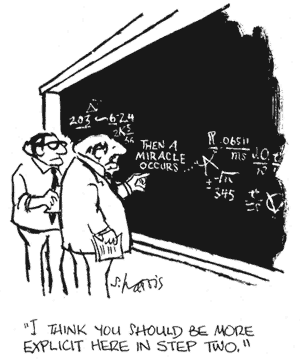
The cartoon below is a good example of what some people imagine about economic theories. They forget that graphs must be placed into practice, and so they are essentially saying "A Miracle Occurs"  


Mark and I assigned our students to read a Bruce Yandle article titled "Much Ado about Pigou". Alfred Cecil Pigou was the father of the idea that taxes could be used to correct negative externalities. An idea that Yandle points out is gaining significant popularity in a myriad of arenas: taxes on soda (to curb obesity) and taxes on large banks (to curb risky behavior). But, even Pigou did not believe that policy happened in a vacuum. He offered this valuable insight:

 [W]e cannot expect that any public authority will attain, or will even wholeheartedly seek, that ideal. Such authorities are liable alike to ignorance, to sectional pressure and to personal corruption by private interest. A loud-voice part of their constituents, if organized for votes, may easily outweigh the whole.

In short, public choice is worth studying because we need to understand: votes are to politicians what profits are to businesses. Sometimes policies are adopted, not because they generate more benefit for the body politic, but because they benefit an important set of people. Finally ---and this speaks to Pigou's statement that "authorities are liable alike to ignorance"--- even if politicians were well intentioned, there is no single Great Mind that could calculate the social costs or benefits needed to arrive at a corresponding tax or subsidy.

Tuesday, February 1, 2011

The Sword and the Covenant

Yesterday in our sustainability class Mark and I discussed Common Pool Resources and Public Goods. These two categories of goods are listed in the 2x2 matrix from my earlier post titled "public goods". But, in this blog post I'm talking about Common Pool Resources which characterize many environmental goods: aquifers, wildlife, forests, fisheries, oil, grazing pastures, etc.

Common Pool Resources are non-excludable but rivalrous. This means that you cannot exclude people from consumption (non-excludable), but, each persons consumption subtracts from your ability to consume (rivalrous). To see an example check out the video below from Curb Your Enthusiasm (watch until about 1:32): ***I changed the embedded video to a link***


The caviar is a common pool resource. More than sheer comedic shtick, what Larry David said has a corresponding truth in the world beyond television ---and more important than caviar. How do people manage natural resources when there is an absence of private property? The popular prediction came from scientist Garrett Hardin. He presumed that each person, acting in their own self interest, would lead their sheep to graze until there was no more grass on the meadow. This would result in a "tragedy of the commons" where the resource would be depleted beyond its ability for future use.

Yesterday, we discussed Elinor Ostrom's work. She is the first female Nobel Prize winner in Economics. She discusses Hardin's idea and her idea in the following video.


The ability to manage the commons fundamentally comes down to two public goods: covenant and sword. By covenanting, or coming up with a set of rules for the commons, people are providing the public good of order. By monitoring the usage of other members of the community and punishing them when they do not abide by the agreement, people are providing the public good of scrutiny.

There are a wealth of examples on how people manage the commons. Managing the commons even exists as a story in the Bible! But, I will close with an example from Elinor Ostrom's own work from Nepal:

One of my own vivid recollections from doing fieldwork in the Middle Hills of Nepal during the 1990s was seeing an enclosed field with a domesticated cow in the center of a village.In response to my question as to what was happening here, my Nepali colleagues indicated that
the enclosure was a kind of “cow jail.” When three adult members of the local farmer-managed
irrigation system agreed that a member had not followed water harvesting or maintenance rules
after receiving a verbal warning, they were authorized to bring a cow from the errant farmer’s
fields to the village area. In an agricultural village, everyone knows who owns a cow. Thus,
while the cow was grazing in the center of the village producing milk for village council to
distribute, all of the farmer’s neighbors were learning about the farmer’s nonperformance. Once
the farmer had paid a modest fee for breaking the rules, the cow would be returned, so this
second-stage sanction was not severe in the long run. Needless to say, however, most members
of the irrigation system preferred to follow the rules rather than being embarrassed by this form
of a graduated sanction.