Showing posts with label Politics. Show all posts

Thursday, November 8, 2012

Some Thoughts on the Election

I am stuck in Atlanta. Shockingly this is not the fault of Delta but Greyhound. Since I'll be sitting here a while (until 4am) it seemed like a good time to write. The last few days have been despairing and there has been an albatross question hanging on the conservative community, "How did this happen?" I thought it would be like chicken soup for the soul to chronicle the recent happenings from my perspective.

In the primaries Romney did not energize me, but, neither did the other candidates. Then a couple months passed and he selected Paul Ryan as his running mate. That started to get me excited. Having seen Paul Ryan speak a couple times he struck me as articulate and principled. The Ryan selection gave me a reason to believe this could be a supportable ticket.

But, the conventions did not really provide much boost in the polls and Mitt did not seem comfortable giving stump speeches and marshaling campaign rallies. Then the awkwardness was replaced with a dynamite performance in the first debate where he caught President Obama flat-footed. After the first debate, liberal commentator Chris Matthews was asked for his thoughts, "I don't know what [Obama] was doing out there. . .What was Romney doing tonight? He was winning! If he does five more of these nights, forget it! That's my thought". In that hour-and-a-half I started thinking of him as a real candidate with a shot at winning. He brought up his business acumen. He seemed committed to casting off regulatory burdens for businesses and working towards a solution for the mounting debt. These were good signs. A bunch of other people must have seen things in a similar light. The buzz vaulted him passed Obama in the Real Clear Politics average. That was the first time in the election cycle the Republican candidate outperformed President Obama in the poll averages


From the graph you can see the average reflects, more-or-less, a momentum in favor of Romney throughout the debates; however, towards the end of October this momentum waned. What happened? I'm sure you are aware of the banter:

  1. Romney seemed to coast and there was no final burst to the finish line.
  2. Obama had a great "ground game" to help Democratic voter turnout
  3. Obama appeared bipartisan when photographed with Chris Christie
  4. Romney did not hammer home on the Benghazi incident
  5. ETC. 

All of those things probably had some impact. Large numbers of Democrats are citing negative spillovers on the Republican Party from their Tea Party segment. In a similar vein some pundits are telling the Republican party there are branding problems and the country wants their message to be more moderate. While I do not agree with every plank in the traditional Republican platform (most notable immigration and death penalty) I do not believe this is the real problem.

Romney ran on the economy and did not touch other issues. Hammering home the poor economic performance was the best strategy available. See the graph below. But, notice, this does not account for the 3rd quarter growth of 2%. Not that 2% is something special but it represented an improvement over 1.3% in the 2nd quarter:


The recent economic conditions, however dismal, were showing an improving trend. While unemployment numbers were not fantastic ---increasing from 7.8% in September to 7.9% in October it was not an egregious increase. I am arguing that these numbers sowed thoughts of, "Give it time," in the electorate. The folks over at Monkey Cage were writing that the incumbent advantage combined with improved growth numbers did enough to push Obama over-the-top.  


In fact, it is possible that we are starting into recovery. Macroeconomists think that business cycles last about 7.5 years. Given that the United States started into the bust part of the cycle in late 2007 we should see recovery with some good policies. Will this be a U-shaped recovery or a W-shaped recovery? Not sure. I'm hoping that Tyler Cowen provides some insight on the topic at the Southern Economic Meetings. Of course, there is also the prospect that things will get worse. We do not know how negotiations with the fiscal cliff will work out. That will be a game-changer with big consequences for well-being in the United States.

So the conversation does not end here but keeps going . . .

One thing is clear: Life is still wonderful. God is still constant, unchanging, and good. I am thankful for the grace offered through Jesus Christ. I am excited about the spirit working in me, pushing me in the process of sanctification. I am thankful for my wife, family, and friends. I'm certain that God can use us to advance His kingdom. So there is still purpose, meaning, and loving relationships. These things will never depend on what political party wins the election.        

Friday, June 17, 2011

Friday Link II: If You Are in the Center of the Road, You Are Likely to Get Run Over

When I worked in the United States Senate, I developed what I've found to be an unusual dislike for self-proclaimed "moderates". I observed that the senators with an ideology, whether "conservative" or "liberal" were most likely to be acting to further that ideology. In other words, their constituents got what was advertised in the election. For example, at one point in a fit of historical amazement, New Yorkers elected Jim Buckley (William F. Buckley's brother) as a senator. He voted exactly as he had campaigned, and was one of the most principled senators I had the privilege to observe. Sen. Buckley was defeated after one term as New Yorkers returned to their more liberal traditions. I suspect Jim Buckley wouldn't have it any other way. Senator Birch Bayh was a similar example on the opposite side of the political spectrum. In my estimation, it was the "moderates," the "centrists," the "liberal Republicans" and "Conservative Democrats" that you had to watch with suspicion. I realize that this is a broad generalization (obviously it was not the case that no liberal Republican or conservative Democrat had principles) , but because this picture is contrary to what many people suspect, I wanted to put it out here for discussion.

Sometimes I have viewed columnist David Brooks as an embodiment of everything I distrusted in this fashion. His columns seem to have the "if only we could get all the smart, reasonable people together" mentality that I thought brought disaster upon disaster to the US in the 1970s. So imagine how stunned I was to see his column today in which he takes to task exactly this "establishment" class for the scandal that was Fannie Mae.

(Thanks to Hot Air for the tip to the link.)

Thursday, April 28, 2011

Galt's Gulch, South Carolina

Readers of this blog will recognize that I am not a fan of Ayn Rand. Therefore, it's somewhat distressing to read news reports that move me to say "Here's a case where Ayn Rand was prescient." I'm referring to the attempts by the National Labor Relations Board to tell the Boeing Corporation it cannot manufacture its airplanes in South Carolina. This is outrageous. The NLRB ought to be added to the list of federal agencies (EPA, FCC) where the power of the purse of Congress should be used to reign in abuses of federal power over economic activity. To go further, I suggest a sweeping re-examination of all of the Progressive Frankenbureaus who believe that they can order Americans around outside of the originally-understood concepts of separation of powers.

Friday, April 15, 2011

Who Wants to be a Spillionaire?

For a variety of reasons (public relations, political pressure) BP approached the problem of damages along the Gulf Coast in a proactive way, that is, agreeing up front to pay damages through what were largely political rather than judicial processes. The investigative journalism group ProPublica has looked at the result, and it's not pretty. In fact, that title phrase "spillionaires" says a lot. It's the classic case a lot of money to be had through what are essentially political connections rather through competition in the market (or, in this case, rather than through a more measured, but slower, common law process). It's also a case study as to why economics students need to be repeatedly made aware of the "public choice" aspects of non-market decision making. Oftentimes, "market failures" are compared to some idealized non-market utopia. But nothing is going to cause human beings to discard the same human weaknesses that cause problems in the market just because they switch to some alternative resource allocation process, especially when there is so much money at stake, as in this case.

Saturday, March 19, 2011

Plowshares into Cruise Missiles: View from the Crickets

There are many legitimate views on Christianity and issues of wars and peace: pacificism, "just war" theory, humanitarian justifications. However, I've said for a long time that there is one such theory which, I believe, holds no such legitimacy:

A war is "just" if and only if the President launching it has a "D" after his name.

Now, with no Congressional debate or resolution, no hint that this bombing involves the self-defense of the U.S. or its citizens, America is firing cruise missiles onto territory controlled by the Qadaffi regime in Libya. I just spent several minutes on Google looking for things like "Presbyterians oppose bombing of Libya" or "Moderator comments on Libyan bombing." I more or less went through all of the usual suspects. The result so far: nada, zilch, goose-egg. The PCUSA Peacemaking Page is simply reprinting the US announcement of the UN resolution authorizing the attacks, with no editorial comment. It will be interesting to see what the next few days bring.

Full disclosure: I support the international coalition's actions, with reservations. That's not the point. I'm giving a President I didn't vote for the benefit of the doubt (I think he dithered for too long to get to where we are, but that's a different argument). My argument is that much of the "peace movement" in mainline protestant and even evangelical circles goes silent when a "D" is the one launching the bombs. This is not the first time this has happened: take some of the most strident religious critics of the Iraq war and google their statements about either 1 ) The Clinton administration's massive aerial bombing of Serbia or 2 ) The decision by President Obama to escalate the war in Afghanistan. Largely, I am willing to argue, things are so quiet you will just hear the sound of crickets chirping in your back yard. If you want to search the record for a principled counter-example, I offer you Joan Baez, who alienated herself from the antiwar establishment by opposing war and violence from whatever direction in the political spectrum. That and, of course, she has the voice of a song-bird. And, I did see a news report that famed economist Daniel Ellsberg marched in front of the White House today with about....100 people?

Thursday, February 10, 2011

The Nature of Rent Seeking

Last week I wrote about the field of Public Choice, which is the application of economics to the political process. One of the best known ideas from Public Choice concerns "rent seeking". This blog post is a riff on a recent Econ Talk podcast with Mike Munger and Russ Roberts.

David Henderson breaks down the term "rent seeking" in the Concise Encyclopedia of Economics

David Ricardo introduced the term “rent” in economics. It means the payment to a factor of production in excess of what is required to keep that factor in its present use. So, for example, if I am paid $150,000 in my current job but I would stay in that job for any salary over $130,000, I am making $20,000 in rent. What is wrong with rent seeking? Absolutely nothing. I would be rent seeking if I asked for a raise. My employer would then be free to decide if my services are worth it. Even though I am seeking rents by asking for a raise, this is not what economists mean by “rent seeking.” They use the term to describe people’s lobbying of government to give them special privileges. A much better term is “privilege seeking.”

That is a good explanation and jives with the popularity of the idea in Public Choice. But, the hallmark of rent seeking is that it is a contest. Each person in the contest allocates resources towards the goal of winning the contest. Whether they win the contest or not the resources have been spent. These exercises cause resources to be spent in unproductive ways. Yet, these contests exist beyond government lobbying for the right piece of legislation. These contests also exist in patent races for technology between private firms. What makes the rent seeking for the right legislation and technological races different? Discovery and Feedback.


When firms in the market compete in a contest to have the best technology new products are discovered that improve the lives of consumers.  These contests can sometimes be pretty risky. Firms do not necessarily know in advance how valuable a product could be. But, if those products are not valuable to people the firm will receive "feedback" from the market that what they are selling is not in demand. Then, they will go back to the drawing board to try to invent new products that are valuable. There is some waste in the discovery process because not everyone who allocated resources is rewarded for their invention. Firm competition, however costly, ultimately leads to consumers being able to purchase goods that are valuable to them. Because consumers can discipline firms they can direct innovation.

On the other hand, I'm having trouble understanding what contests over legislation discover. Also, I'm having trouble understanding how the feedback works in the political process. This is a topic for another day.


Wednesday, February 2, 2011

Public Choice: Politics without Romance

Two of my classes today happen to cover the same material: public choice. Public choice is the application of economic models of self-interest to political science. The central assumption is that politicians are not glowing angels of virtue but prone to the same self-interested behavior as we might expect from anyone else. Basically public choice is, in the words of James Buchanan, "politics without romance".

Studying public choice is vital because people are susceptible to misconceptions. The moment economists admit that the market is imperfect due to problems such as public goods provision or externalities there is mass zeal for corrective interventions such as subsidies and taxes. Yet, this may not always be a good idea. The more legitimate question to ask is not whether the market is perfect; but, whether the political process is better.

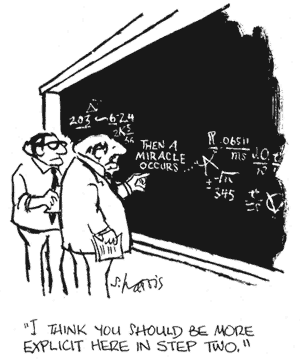
The cartoon below is a good example of what some people imagine about economic theories. They forget that graphs must be placed into practice, and so they are essentially saying "A Miracle Occurs"  


Mark and I assigned our students to read a Bruce Yandle article titled "Much Ado about Pigou". Alfred Cecil Pigou was the father of the idea that taxes could be used to correct negative externalities. An idea that Yandle points out is gaining significant popularity in a myriad of arenas: taxes on soda (to curb obesity) and taxes on large banks (to curb risky behavior). But, even Pigou did not believe that policy happened in a vacuum. He offered this valuable insight:

 [W]e cannot expect that any public authority will attain, or will even wholeheartedly seek, that ideal. Such authorities are liable alike to ignorance, to sectional pressure and to personal corruption by private interest. A loud-voice part of their constituents, if organized for votes, may easily outweigh the whole.

In short, public choice is worth studying because we need to understand: votes are to politicians what profits are to businesses. Sometimes policies are adopted, not because they generate more benefit for the body politic, but because they benefit an important set of people. Finally ---and this speaks to Pigou's statement that "authorities are liable alike to ignorance"--- even if politicians were well intentioned, there is no single Great Mind that could calculate the social costs or benefits needed to arrive at a corresponding tax or subsidy.

Thursday, February 18, 2010

The Role of "Cheap Caulk" in Providing Public Goods

Why do some of us conjecture that government is less efficient than the voluntary sector at helping people? How about the following report from ABC News and then Daniel Foster at NRO.com. So far, the federal government has paid $522 million in its home-weatherization ("cash for caulkers") program, and has actually weatherized either 9,100 or 22,000 homes, at a cost per home of between $24,000 and $56,000. Detailed data from one state (Texas) puts the cost there at $78,000 per house with only $4,255 due to materials and labor. All of the rest is the administrative costs in the system (even the $4,255 may be greater than what voluntary charities would have spent because of federal "prevailing wage" requirements).

Supporters of the federal program say that this is misleading because of most of the $522 million has been spent in start-up costs. But that's the whole point. For example, Federal bureaucrats had to spend months going county-by-county through the U.S. calculating what the "prevailing wage" for caulking really was, just so the program could begin. That's the waste. That's what a voluntary program would never have had to do.

I don't have the link, but a recent newspaper article here in Tallahassee suggested that a large chunk of the major savings for low income individuals was sometimes in just demonstrating that turning off lights or adjusting thermostats by even one or two degrees could make a serious difference in the monthly utility bill. And good caulk can be gotten for about $6.00 a tube.

Some people may argue that the real objective of the program isn't to help poor people, but rather to perform a macroeconomic stimulus function. But it appears that all of the rest of the country has just spent $525 million to stimulate the economy of the Washington D.C. metropolitan area, as if it needed any more stimulus.


Wednesday, January 20, 2010

Hit the "Reset" Button

I didn't blog in great detail about the Senate's version of the health-care bill. A short summary is that I thought it was superior to the House version in principle but that it collapsed into a morass of special interest deals and unintended consequences that made it one of the worst pieces of legislation I've seen since I worked in the U.S. Senate in the 1970s. The unexpected election of Scott Brown in the Massachusetts U.S. race seems to afford a window for Congress to go back to the drawing board and produce a truly bi-partisan and measured piece of legislation.

So, what would I actually recommend (after all of these posts commenting on what other people have proposed)? I thought about this last night, and I think, if I were the new health-care-reform czar (presumably the President will want to listen to some new advisors after the Massachusetts election) here is what I would propose:

1 ) Get Republicans on board with two things that they think are important:

a ) Use the Interstate Commerce power of Congress to stop states from restricting interstate sales of medical insurance. Specifically, deny the states the power to insist on expensive bundles of mandates. Fire up a market for no-frills insurance, what in my parents' day was called "major medical" insurance. Let the medical insurance companies compete on price and quality like GEICO and Progresssive and Allstate do on automobile insurance.

b ) Include tort reform to restrain the costs of medical malpractice insurance.

2 ) Keep the "Cadillac tax" idea from the Senate bill, but make sure that the cut-offs are indexed for inflation.

3 ) Estimate the revenue gained from # 2) above. Call this revenue $M. Get together a top-rated collection of health economists, and tell them that they have $M to work with, and ask them to design a system with the following three possible uses of that money to find the most effective and least disruptive ways to expand current medical insurance access:

a ) Return the money to the states so that they can increase the Medicaid eligibility limits. In other words, don't impose unfunded mandates on the states such as the ones that led to the infamous "Nebraska exception". If we want states to expand Medicaid, provide them with the money to do so.

b ) Offer a refundable tax credit for individual purchases of medical insurance.

c ) Use the money to require the interstate competitors (see # 1 above) to participate in a "high-risk" pool for people with prohibitive pre-existing conditions. (This is similar to how many states deal with "high risk" drivers.) This might include a new mandated "no-pre-exisiting-condition-exclusion" benefit for anyone who is covered by any sort of insurance policy as a child, and who agrees to stay in some policy as he/she becomes an adult.


Tuesday, April 14, 2009

Rock, Sand, and Scissors Cut Both Ways?

I remember a certain group of mainline Protestants and "emerging" Christian social activists who practically had apoplexy ever time they imagined that former President George W. Bush was using some kind of secret coded language to make his policies appeal to Christians. "Jesus was not a Republican or a Democrat" they constantly reminded us. Well, I just heard President Obama directly and explicitly (not in code) compare his proposals for drastically increasing federal spending to Jesus' words in the Sermon on the Mount (specifically the parable of the wise and foolish builder).*

I propose the following questions for discussion.

1 ) Will these folks I mentioned use the same standard in judging President Obama's appropriation of Christian theology for his own political purposes? Or, is Jesus now a Democrat?

2 ) The Bible verse in question is not a generic proverb. In raising the question of rock versus sand, Jesus was not making a generic reference to being wise, he was talking about people putting into practice His own words. The parable incorporates all that Jesus has said up to that point. Therefore, is President Obama suggesting that people who disagree with his spending policies are not merely unwise but are also specifically opposing Jesus teachings? Which ones? Would that include, "So when you give to the needy, do not announce it with trumpets"? Or how about "Watch out for false prophets. They come to you in sheep's clothing, but inwardly they are ferocious wolves"?

* source: A YouTube video clip of a CNN feed of the President's speech linked on Townhall.com.

Saturday, March 28, 2009

Saturday Musings: You, Too, Can Exit

One of the problems of government as a solution to social problems is that its monopoly position leaves very few mechanisms for discipline. One of those few is exit, which is a whole heck of a lot easier the smaller scale is the government we're talking about. In Pima County, Arizona, you can move across the street and get into another fire district or school district, or move not too far at all and live in another city or in no city at all. Even this reflects the typical American approach of tying K-12 education to the parents' address. But notice that we usually stop there. If we at FSU (or the faculty at any other Florida university) mess up on the quality of education we deliver, then any high school senior anywhere in Florida has a long list of other places to go. At the university level, "school choice" is not a abstract policy debate, it's a fact of life.

Mark Steyn emphasizes the importance of "exit" somewhat of the way into his article on "Obama's False Choice." When reading this, I saw that he asserted that social activist Bono had moved some of his business from Ireland to the Netherlands to reduce his tax bill. I wondered what the details were on this, and "through the magic of the internet," I found them in the Irish Times. Not suprisingly, social activist Bono is "stung" by criticism of hypocrisy. I say, "Way to go guys" and "I hope you keep in mind how important "exit" is in disciplining government when you continue your campaign to help Africa."

Saturday, March 21, 2009

Thou Shalt Not Covet Thy Neighbor's Bonus...

....nor, for that matter, steal it back, nor declare falsely about whether you knew that the bonuses were not only legal but specifically protected by your own legislation. If you are really careful, you might even be cautious about bowing down to the false God of valuing whatever the overnight tracking polls are saying.

If we think the 10th Commandment is just about oxes and donkeys were are deluding ourselves. If we think that our "neighbor" is just someone who lives on our block, then we've probably never read any of the Gospel, becuase she is also that Samaritan in suburban New York who was asked to stay on a job at a dying company (something my Dad was once asked to do). It is precisely because we think that it seems so obvious that "I don't like that the stranger far away has that bonus" that we need to tread very carefully.

Finally, as has been a constant theme in my posts, it seems to me that where the Lord really gets upset is when these sins are enabled by the forces available to the powerful. Or, as Protein Wisdom currently puts it, "They came for the AIG bonuses, but I was not an AIG employee..." (My thanks to Instapundit for pointing out the link).

Monday, February 16, 2009

Enforcing Jim Crow

Jeff Jacoby has a concise but detailed recounting of the fact that Jim Crow laws in the segregated South were the creation of governments.

Wednesday, January 28, 2009

Rent Stimulus

I recently mentioned "rent seeking" as a weakness in the argument for government provision of public goods. The idea (made famous by Anne Krueger and Gordon Tullock, among others) is that productive resources are wasted in attempts by political actors to move monopoly rights or other things of value away from other people and towards them. One classic example was under federal control of airline routes as airlines and their lobbyists spent big bucks to make sure they, and not some other airline, received the so-called "route authority" to fly from Oz to Shangri-la.

The Wall Street Journal's front page article this morning was an amazing and graphical depiction (it should have been rated PG-13 for "too intense for the weak stomached") of the swarm of lobbyists descending on Washington to make sure that their interests are protected, funded, and otherwise promoted in the current economic stimuls bills. My favorite example was on what seems like it should have been one of the most straight-forward parts of the program: road construction. But what I didn't know is that new road construction uses relatively more concrete and relatively less asphalt, while repair of existing roads typically uses more asphalt and less concrete. I will leave it as a homework exercise to guess which industries' lobbyists were working hard to make sure that the legislation imposes the "right" language with regards to new road construction versus old road repairs.

Shouldn't the old, old idea of "Thou shalt not covet ..." come into play someplace in here?