Showing posts with label General Economics. Show all posts

Thursday, November 1, 2012

Who's in your top 5?


I just ran across an article that was helping to prepare PhD candidates for the job market. Here. In perusing the article I came across a list of common questions. One question stood out:

Which senior economists do you wish to emulate? Why?

Watching football at a friend's house over a year ago I remember he asked me this question. At the time I didn't have a very good answer, it wasn't a question I had given much thought to. But tonight I spent some time thinking about who is in my top 5 and the qualities they have. Without further ado, 

Ronald Coase - His willingness to ask what appear to be obvious questions like "What is the nature of the firm?". Even when others condemned those questions as silly he pressed on. Also, his exhortations to go out into the field and study how the world actually works are important.

Charles Plott - His intellectual curiosity spans multiple fields and he demonstrated that experiments could be relevant for both policy and firm-level decision-making.

Daniel Hungerman - His econometric work really opened my eyes to interesting public economic questions when the only research experience I had was in doing experiments. Also, his research in the field of Economics and Religion has been really interesting because he has been a forerunner in attempting to identify causal relationships between religion and economically/politically relevant action (which is really hard to do).       

Elinor Ostrom - Her work on polycentrism (multiple centers of authority) demonstrated institutional nuance in what can become a heated and dichotomous debate of government versus non-government. Also, she had a fantastic and kind personality in addition to being a top-notch scholar.

Mark Isaac - He has done a lot of significant experimental research on public goods provision and topics in industrial organization.  Anyone would like to make such contributions to their field; however, that is not the main reason Mark is in my top 5. Anything I accomplish in economics will be because of his mentorship. His patience in listening and his friendship have benefited me more than economics but also in showing how to be a virtuous man. If I am half the teacher to my students Mark has been to me I will be doing a great job.

Friday, June 17, 2011

It's Friday: Here is One Link

One thing that we've noticed in Doug's Theory of Moral Sentiments Readings Group is that Adam Smith endorses the day to day functioning of commerce more than he ever idolizes "Big Business." In that light, this commentary by University of Chicago economist Luigi Zingales on the current American political situation is interesting. A "median" voter position right now might be enthusiasm for markets but distrust of "big business." (It should be noted that Zingales is the co-author of a book titled Saving Capitalism From the Capitalists).

I have a couple of reactions to this sentiment. Many of the respondents may frame their worries in terms of business abuses in the market. I am more worried about firms that are able to manipulate the government in order to protect their position in the market: what is currently known as "crony capitalism." Secondly, this distrust of "business" leaves open the question of the entrepreneur. I have a feeling that most Americans like the idea of somebody who creates wealth from an innovative product or service. When that entrepreneur is an outsider, then two streams mentioned by Zingales would seem to mesh. But what happens in those cases where the innovator is an established entrepreneur...someone already "big"? Then I think we see the kind of love/hate relationships that Americans currently express towards Microsoft, Nike, Apple, Google, and Facebook. We buy a lot of iPhones (Steve jobs wasn't working out of his parents garage when it was introduced) , but we are always keeping a wary eye on the "bigness" of these companies.

Finally, this kind of discussion perpetuates the idea that "the opposite of the government is 'the market'." As I'm know people get tired of hearing me say: the opposite of "the government" is voluntary activity. Sometimes this is the market, sometimes it could non-profit collective organization. In either case, firms and non-profits struggle to find the boundaries of the market and their own, preferred hierarchical or cooperative organizational boundaries. This is one of the hallmarks of the new institutional economics studied by people such as Williamson, Coase, Buchanan, Davis, North, and Alchian. Firms (and even non-profits) compete in the market, but within the firm or non-profit there are institutions and institutions help to shape behavior.

(Note: thanks to NRO for the original link to the Zingales article)

Wednesday, June 1, 2011

Would You Like Staples With Your Copies?

Extending Doug's discussion on the EITC and the minimum wage, in the comments on my May 12th post on the minimum wage, I was in a good discussion with Brandon V., and I mentioned that I couldn't figure out why it was legal for middle class and upper class "kids" (actually young men and women who years before would have been in the workforce, but that's another blogpost entirely) can work for free in "internships" but it's illegal for a young man or woman from the inner city who wants to build up a skill set to work for a training wage of $5.00/hour. Interestingly, over the past three weeks or so that same idea has cropped up on several different websites.

I recall that in Oklahoma, state Prohibition lasted longer than federal Prohibition, and one of the reasons it was finally repealed was the state actually started enforcing the law. Maybe the only way to get a training wage is for the Obama Administration to start shutting down internships for the well-to-do.... to enforce the minimum wage law across the board.

Saturday, May 28, 2011

William Parker and the LAPD, Part I

So how corrupt was the LAPD in the 20s, 30s, and 40s? Let's look at some popular culture references.

In the movie Changeling, one [in fact, two] courageous pastors use a religious radio broadcasts to expose the LAPD incarcerating in a mental hospital an "inconvenient" woman who was making charges against the department. Numerous accounts that Doug and I accessed confirm that the basic underlying story is TRUE.

In the novels of Raymond Chandler, the LAPD of the late '30s and early 40's is depicted as a mixture of some good cops and some that are lazy, incompetent, and on the take from various corrupt activities. In fact, more than one of the historical accounts claim that the LAPD of the period was, if anything, worse than Chandler depicted (certainly worse than the version depicted in the movies made from his novels). In the late 1930's, a crusading group of civic reformers, again with strong ties to local religious leaders, gained power on the county grand jury and began exposing civic corruption. The local news media, especially the vibrant competition between the Times and the Examiner, kept the story before the public. Representatives of the reform group were subject to violent attacks. Eventually, Mayor Shaw was recalled and his brother indicted over a scheme to sell police and fire commissions. (The, um, checkered history of the LA County District Attorney is another movie waiting to be made. ) The recall of Shaw installed reform-minded Fletcher Bowron.

The movie L A Confidential (based on the novel by James Ellroy) shifts in time some important events that occurred in the 1940s while Bowron was mayor. The police, under new leadership, put intense pressure on leaders of organized crime to leave Los Angeles. Many left for Las Vegas. Mickey Cohen was indeed the face of the mob to most citizens of Los Angeles. But, in 1949, the news broke that a prostitution ring was being run with assistance from inside the LAPD. As far as we could tell, LAC's depiction of the plastic surgery to create prostitutes who resembled famous movie stars is fiction, but the Brenda Allen prostitution scandal and other concurrently revealed events were the reason that the LAPD needed a new police chief, and with a one vote majority on the Police Commission, that chief was William Parker.

Finally, here are the answers to our previous questions about famous fictional photos. Parker helped to make the honest, tough, hard working officer Joe Friday of "Dragnet" the face of the LAPD. At some point, Parker needed some help writing speeches, and the job went to an officer with writing talents named Gene Roddenberry. Two of our sources state that Roddenberry modeled the character Spock after his former boss, William Parker. And while the movie L A Confidential has a new, reform minded chief in the script, many of the personal characteristics of Ed Exley suggest the younger William Parker (right down to the glasses).

One of our best sources for the paper is the history L A Noir by John Buntin. And if you want to see how Joe Friday became a cultural icon, this clip is not to be missed.

Friday, May 20, 2011

The Reform of Corruption: The Case of the LAPD


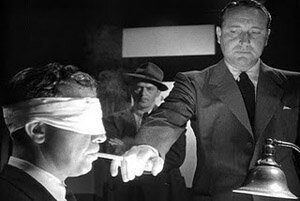
In the 1930, Los Angeles was an extraordinarily corrupt city. A columnist in TIME referred to the city as the slobbering civic idiot of American municipalities. Police and fire commissions were being sold. Author Raymond Chandler artfully depicted a police force riddled with sloth and bribery, only slightly less bad than the hideous "Bay City" police in his Philip Marlowe novels. A serious reform movement in the late 1930s seemed to bring things under control, then just as TIME appeared to revise its view of LA in 1949, a scandal involving a prostitution ring operating inside of the LAPD threatened to revive the image of the LAPD of Raymond Chandler. (The picture above is a depiction of an LAPD interrogation in the movie Murder My Sweet appearing on the website piddleville.com)

In this sordid environment, the Los Angeles Police Commission appointed William H. Parker as it's Chief. And something remarkable happened. Within a handful of years, Parker had cleaned up the LAPD, so that by the mid 1950s it was being looked to as a model of police professionalism. The picture above right is Parker, as taken from the official LAPD website.

How did this happen? How was Parker able to steward such a remarkable and rapid turnaround? What are the implications for the elimination of corruption in the developing world. Doug and I have a new paper: "Just the Facts Ma'Am: A case Study of the Reversal of Corruption in the Los Angeles Police Department," looking at these questions.

Background reading is tedious, but background watching can be fun. So the question is: what do these fictional characters have in common? (Sgt. Friday is from the official LAPD website, Mr. Spock is from Wikipedia, Ed Exley is from this review of L.A. Confidential in Slate.com.)


Tuesday, May 3, 2011

What?

Topic for investigation tomorrow regarding Protestantism and Capitalism: what was the Speenhamland Law? More to follow.

Thursday, April 28, 2011

A Plethora of Rankings in Lake Nogebow

I've lived in six states and the District of Columbia, and for some reason it took me years to notice the following pattern. Everywhere I lived there was, at some point, a debate in the public sphere that went something like this: "I don't know how we can expect people to want to move to ____ when everyone knows we rank [45th, 46th, ....51st] in Ranking X in quality of education." The thing is, I heard the same thing from people who lived in other states which were supposed superior to my state. One curious thing was that it was never a single, comprehensive criterion: it varied from state to state: per pupil spending for education, teacher salaries, spending on education as a percentage of personal income, class size, graduation rates, SAT scores, etc. etc.

So, a while ago I decided to try a little investigation of this phenomenon on the internet. I went onto search engines, and typed in, in Alphabetical order, "State A ranks 45th in education", State A ranks 46th in education"; etc . It was eye opening. Primarily in regional and local newspaper reports, editorials, and letters to the editor, I realized that the United States as a collective was a giant educational Lake Nogebow --a reverse Lake Wobegon where almost everyone is below average in education according to some ranking. I have a small map on my wall. Send me a comment if you want me to tell you how bad your underachieving state really is (I think I found that somewhere around 40 of the states ranked 41st - 51st in some category; unfortunately I didn't keep track of all of the categories by state).

The political economy of this rankings game is obvious. Create enough rankings and almost every state will fail in some category X, much to the delight of whatever lobbying group wants more taxpayer funding for X. The job of the education economist is to make some sense about which of these rankings actually matter. The whole class-size debate is ongoing and most of what I have seen is not encouraging to the idea that lowering class size is a cost-effective way of improving student performance, at least not in higher grades. Some of the rankings are undoubtedly in conflict: higher drop-out rates could correlate with higher SAT scores. It is well known that some of these rankings are completely perverse. Probably the best example is to report average SAT scores without taking account of what proportion of high school students actually sit for the SAT exams. For example, in a state in which in-state schools rely on the ACT, the SAT may be taken primarily by students who already know that they are qualified and/or have the resources to go to a private school out of state. That's an incredibly self-selected sample compared to a state that encourages every student to take the SAT.


Galt's Gulch, South Carolina

Readers of this blog will recognize that I am not a fan of Ayn Rand. Therefore, it's somewhat distressing to read news reports that move me to say "Here's a case where Ayn Rand was prescient." I'm referring to the attempts by the National Labor Relations Board to tell the Boeing Corporation it cannot manufacture its airplanes in South Carolina. This is outrageous. The NLRB ought to be added to the list of federal agencies (EPA, FCC) where the power of the purse of Congress should be used to reign in abuses of federal power over economic activity. To go further, I suggest a sweeping re-examination of all of the Progressive Frankenbureaus who believe that they can order Americans around outside of the originally-understood concepts of separation of powers.

Tuesday, April 26, 2011

The Seen and Unseen

Our training in economics sensitizes us to unseen effects.  For example, Thomas Sowell, the Sage of Palo Alto, writes in his Basic Economics textbook that the question for any policy is, "What happens next?" In other words, we raise the minimum wage and workers will be compensated more money. Ok, but, what happens next? Mark touched on this in his previous post "Truth or Consequences". And, this was the topic of my last review for the Economics of Compassion class.


Economics fundamentally comes down to the seen and unseen:

  1. What is seen in rent-controlled apartments? Lower prices. What is unseen? The underground market created for sub-leasing. The deterioration of property because landlords have no profit motive to improve the property. 
  2. What is seen with welfare payments? More resources for the poor. What is unseen? The high implicit marginal tax rates that reduces the incentive to work (sometimes for each additional dollar earned the poor lose more than one dollar in welfare receipts). 
  3. What is seen with subsidies to farmers? Farmers benefit from the receipt of money. What is unseen? This artificially lowers the price of the crop which makes it more difficult for developing nations to compete in agriculture.  

***Contribute your favorite seen versus unseen distinction to our comments section***

This is well put by French political economist Frederic Bastiat in his book "That Which is Seen, and That Which is not Seen": 
[The inability to think through beyond immediate effects] explains the fatally grievous condition of mankind. Ignorance surrounds its cradle: then its actions are determined by their first consequences, the only ones which, in its first stage, it can see. It is only in the long run that it learns to take account of the others. It has to learn this lesson from two very different masters - experience and foresight. Experience teaches effectually, but brutally. It makes us acquainted with all the effects of an action, by causing us to feel them; and we cannot fail to finish by knowing that fire burns, if we have burned ourselves. For this rough teacher, I should like, if possible, to substitute a more gentle one. I mean Foresight. For this purpose I shall examine the consequences of certain economical phenomena, by placing in opposition to each other those which are seen, and those which are not seen.
  Moreover, I recently learned of 20th century American journalist Henry Hazlitt (influenced by Bastiat) from the APEE meeting. In the book Economics in One Lesson he writes,

The reason is that the demogogues and bad economists are presenting half-truths. They are speaking only of the immediate effect of a proposed policy or its effect upon a single group. As far as they go they may often be right. In these cases the answer consists in showing that the proposed policy would also have longer and less desriable effects, or it could benefit one group only at the expense of all other groups.
To consider all the ramifications of any policy is wisdom ---at least from my "consequentalist" economic perspective. There is a Jewish aphorism that says (paraphrasing): A clever man can extricate himself from a difficult situation, but, a wise man never gets into such a situation in the first place. There will always be the messy business of trade-offs; however, a little foresight can go a long way to making trade-offs less painful.

Tuesday, April 19, 2011

TOMS Shoes

 Monday morning one of my students walked in, sat down, and confessed that the Economics of Compassion course is challenging her thoughts about charity. Then, she asked about my personal opinion of TOMS shoes. This is a brief description of the conversation. But, first let me explain what TOMS is. From their website under "Our Movement",
In 2006, American traveler Blake Mycoskie befriended children in Argentina and found they had no shoes to protect their feet. Wanting to help, he created TOMS Shoes, a company that would match every pair of shoes purchased with a pair of new shoes given to a child in need. One for One. Blake returned to Argentina with a group of family, friends and staff later that year with 10,000 pairs of shoes made possible by TOMS customers.

Why Shoes?

Many children in developing countries grow up barefoot. Whether at play, doing chores or going to school, these children are at risk:
•A leading cause of disease in developing countries is soil-transmitted diseases, which can penetrate the skin through bare feet. Wearing shoes can help prevent these diseases, and the long-term physical and cognitive harm they cause.
•Wearing shoes also prevents feet from getting cuts and sores. Not only are these injuries painful, they also are dangerous when wounds become infected.

•Many times children can't attend school barefoot because shoes are a required part of their uniform. If they don't have shoes, they don't go to school. If they don't receive an education, they don't have the opportunity to realize their potential.

Their goal is what is commonly called a "double bottom line": profit and charity.  And, they are doing quite well at both. Last year TOMS reached the 1 million pair sold plateau (which means they also gave away 1 million pairs of shoes). But, economics fundamentally boils down to what Bastiat called, "That which is seen and that which is not seen". What do people see with TOMS? First, they are fashionable and cool looking kicks but they also see photographs like the one pictured below. Is this a good thing? Maybe.


If that is what is seen then what is not seen? I'll argue that there are three things that may go unnoticed by most people: Opportunity Cost, Paternalism, and Unintended Consequences.

Opportunity cost is what we give up to get something else. The least expensive pair of TOMS shoes are $44 on their website. What else could $44 buy? My pair of sweet Nike's cost $30 on sale. If I wanted to give away $14 that could buy medicines, malaria nets, food, etc. through a variety of NGOs. Additionally, there are really inexpensive pairs of shoes that you could buy at Wal Mart for $14 but are more durable than TOMS. I wore the soles of my TOMS out in short order and my primary mode of transportation isn't my feet!

Paternalism is important because when buying TOMS we're determining what to supply rather than asking what is in demand. Perhaps giving the money to the people directly through a sponsorship program and allowing them to allocate their own resources is better. Do we really know their needs better than themselves? (Obviously Principal-Agent problems factor in when you just give people money, nevertheless, I think this is an important point)

Unintended Consequences are those positive or negative outcomes people did not anticipate. Vivek Nemana made two guest posts (here and here)on the Aid Watch Blog and notes that TOMS shoes actually can be harmful to local shoe markets. If TOMS targets people who would never have bought shoes this is a moot point; however, if TOMS is giving away free shoes to those people who would otherwise be customers in the local shoe market they are destroying demand. At this point you might be asking, "Why is this a bad thing? Now that person has extra money they can spend in alternative ways." That is true; however, what happens when TOMS become less fashionable and less shoes are being given away?

Certainly the work TOMS does in these developing countries has positive benefit. No doubt. Also, in our own country it has brought about awareness with campaigns such as the one on FSU campus a couple weeks ago called, "One Day Without Shoes". In the end my critique of TOMS comes down to the seen versus the unseen.

Truth or Consequences?

The Association for Private Enterprise Education annual meetings had a refreshing number of discussions about the variety of voluntary activities. To use one of my favorite overly simplistic lines, the opposite of government coercion is not the market; the opposite of government coercion includes all voluntary activity, of which market processes are only one example. Speakers such as Elinor Ostrom, Deirdre McCloskey, and George Ayittey spoke on variations on this point in plenary talks, and those discussion continued into several individual paper sessions.

On the other hamd, after returning from the conference, I picked up an article in First Things entitled "The Emancipation of Avarice" by Edward Skidelsky. Anyone who reads this blog would understand why I was attracted to such a title. The topic of the paper is one that I find exciting for Christian economists to debate. Unfortunately, I found the argument of the paper jumbled. About midway in his article, he critiques Mandeville and the Parable of the Bees. If you recall one of my earlier posts criticizing Mandeville, you can imagine I found common cause with his criticisms. But then he seems to draw a direct, if not actually straight, line from Mandeville through Adam Smith and into all of modern economics for what he calls its emphasis on consequentialism. I'm not sure I buy this. (Smith's recent biographer, Phillipson, puts much more distance between Mandeville and Smith, and Skidelsky goes right to the Wealth of Nations, without visiting The Theory of Moral Sentiments. ). But let's stick with the issue of morality, economics, and consequentialism here. Suppose the civic leaders of a nation take Skidelsky to heart to study the writings of Aristotle, Aquinas and Agustine...to "express an aspiration to mold people's characters, to make them less greedy, more generous, and so forth." Further suppose that, steeped in such high philosophical idealism, they enact rent controls, minimum wages, and raise the tax on capital gains to 80%. Is it morally deficient of the consequentialist economist to pound home the empirical reality that these efforts very likely help well-to-do teenagers at the expense of inner city minority workers (minimum wage), create an appropriable property right that benefits mobile jet setters who can sublet their apartments at market rates, all the while degrading the quality of housing serving the poor (rent controls) and end up with the wealthy paying fewer taxes (very high capital gains tax rates)? Doug and I have discussed at length the reverse question: what is the moral position of someone who looks only at their own intrinsic motivations and refuses to discuss the consequences of their actions?

If someone argues that Aristotle believes that enacting rent control creates a virtuous citizen in a virtuous society, then I would argue that either a ) Aristotle is wrong b ) the person who interpreted Aristotle is wrong, or c ) I have a very different concept of virtue. Does that mean that I must necessarily be a consequentialist? I don't know. I do know that Skidelsky seems to support government intervention "to erect safeguards against the powerful human tendency to rapacity." But he has no model of public choice, except where, earlier in the essay, he admits that "In complex, fractured societies, any attempt to rule through direct moral exhortation can lead only to tyranny."

Thursday, April 7, 2011

Some Place Just Froze Over

Who would have thought that San Francisco would be home to a bi-partisan (Bush and Obama administration supported) experiment to use the price system to allocate parking spaces? As the article says, it is going to be fun watching. Will the technology work? Will the economic winners (people who don't have to circle for long periods of time to find a parking place) be able to respond to any anti-market "fairness" complaints?

Thursday, March 31, 2011

I Hate to Say it, but W_ T___ Y__ S_.

With regards to Doug's review of The Big Short , it's too bad that more people didn't pay attention to this article in the American Economic Review, published just after the dot-com bubble crash and before the housing bubble and crash.

Thursday, February 10, 2011

The Nature of Rent Seeking

Last week I wrote about the field of Public Choice, which is the application of economics to the political process. One of the best known ideas from Public Choice concerns "rent seeking". This blog post is a riff on a recent Econ Talk podcast with Mike Munger and Russ Roberts.

David Henderson breaks down the term "rent seeking" in the Concise Encyclopedia of Economics

David Ricardo introduced the term “rent” in economics. It means the payment to a factor of production in excess of what is required to keep that factor in its present use. So, for example, if I am paid $150,000 in my current job but I would stay in that job for any salary over $130,000, I am making $20,000 in rent. What is wrong with rent seeking? Absolutely nothing. I would be rent seeking if I asked for a raise. My employer would then be free to decide if my services are worth it. Even though I am seeking rents by asking for a raise, this is not what economists mean by “rent seeking.” They use the term to describe people’s lobbying of government to give them special privileges. A much better term is “privilege seeking.”

That is a good explanation and jives with the popularity of the idea in Public Choice. But, the hallmark of rent seeking is that it is a contest. Each person in the contest allocates resources towards the goal of winning the contest. Whether they win the contest or not the resources have been spent. These exercises cause resources to be spent in unproductive ways. Yet, these contests exist beyond government lobbying for the right piece of legislation. These contests also exist in patent races for technology between private firms. What makes the rent seeking for the right legislation and technological races different? Discovery and Feedback.


When firms in the market compete in a contest to have the best technology new products are discovered that improve the lives of consumers.  These contests can sometimes be pretty risky. Firms do not necessarily know in advance how valuable a product could be. But, if those products are not valuable to people the firm will receive "feedback" from the market that what they are selling is not in demand. Then, they will go back to the drawing board to try to invent new products that are valuable. There is some waste in the discovery process because not everyone who allocated resources is rewarded for their invention. Firm competition, however costly, ultimately leads to consumers being able to purchase goods that are valuable to them. Because consumers can discipline firms they can direct innovation.

On the other hand, I'm having trouble understanding what contests over legislation discover. Also, I'm having trouble understanding how the feedback works in the political process. This is a topic for another day.


Saturday, February 5, 2011

Final Jeopardy! (I)

"A dispute also arose among them, as to which of them was to be regarded as the greatest. And he said to them, 'The kings of the Gentiles exercise lordship over them, and those in authority are called benefactors. But not so with you. Rather, let the greatest among you become as the youngest, and the leader as one who serves.' "
------Luke 22:24-26

FINAL JEOPARDY ANSWER: This change in Jeopardy! rules is a favorite among economists because it demonstrates how people respond to changes in incentives.

FINAL JEOPARDY QUESTION: What was the end of what economists call "linear payoffs?"


Indeed, the popular game show JEOPARDY! is famous to economists because of a change in the rules between the Art Fleming and the Alex Trebek versions of the show. In the original version, contestants who had positive winnings at the end of all three rounds won that amount of money. In economics, that is called a linear payment scheme. In the new version, only the winner is paid the monetary value of their nominal winnings. In economics jargon, this latter is called a "tournament" payment scheme. A typical prediction in economics is that contestants facing FINAL JEOPARDY will behave in a more risk-loving (and therefore exciting) fashion if only the winner gets a monetary prize. Research that I've conducted with Duncan James of Fordham University demonstrates the general accuracy of the tournament model.

This is the first of three posts on this topic that I hope will do three things. First, argue that Jesus was critical of any transformation of life into inter-personal tournaments. Secondly, I'll give a personal example of the trap of tournament thinking. Thirdly, I hope to reiterate Doug's post below about the importance of understanding fairness and justice issues in non-market allocation.

For the first purpose, I opened with the Luke story... one of the good examples where Jesus warns us against viewing life as a tournament in which we receive utility from rank or status. Another example would be Matthew 20 in the parable of the workers in the field, who were bothered not simply by whether their own wages were just, but also for the relative comparisons between themselves and others.

There is plenty to be said about the direct dangers of money or power, but without any doubt Jesus warns us against treating life as a tournament in any aspect: monetary, political, or in our faith. Jesus is saying that he who dies with the most toys wins nothing, and that coming to Christ before someone else is nothing at all like Michael Phelps beating someone else to the buzzer.

(I guess it's a bad coincidence but an instructive lesson to me that this post arrives the day before that ultimate American tournament: Super Bowl XLV or whatever its Roman Numeral is this year, and only a few days after I posted on Facebook the exciting news that FSU was ranked "#1" on college football signing day.)

Wednesday, February 2, 2011

Public Choice: Politics without Romance

Two of my classes today happen to cover the same material: public choice. Public choice is the application of economic models of self-interest to political science. The central assumption is that politicians are not glowing angels of virtue but prone to the same self-interested behavior as we might expect from anyone else. Basically public choice is, in the words of James Buchanan, "politics without romance".

Studying public choice is vital because people are susceptible to misconceptions. The moment economists admit that the market is imperfect due to problems such as public goods provision or externalities there is mass zeal for corrective interventions such as subsidies and taxes. Yet, this may not always be a good idea. The more legitimate question to ask is not whether the market is perfect; but, whether the political process is better.

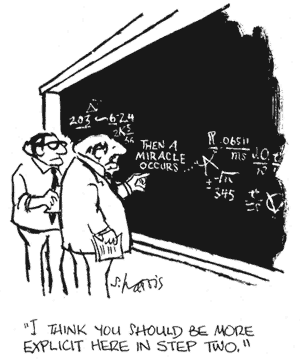
The cartoon below is a good example of what some people imagine about economic theories. They forget that graphs must be placed into practice, and so they are essentially saying "A Miracle Occurs"  


Mark and I assigned our students to read a Bruce Yandle article titled "Much Ado about Pigou". Alfred Cecil Pigou was the father of the idea that taxes could be used to correct negative externalities. An idea that Yandle points out is gaining significant popularity in a myriad of arenas: taxes on soda (to curb obesity) and taxes on large banks (to curb risky behavior). But, even Pigou did not believe that policy happened in a vacuum. He offered this valuable insight:

 [W]e cannot expect that any public authority will attain, or will even wholeheartedly seek, that ideal. Such authorities are liable alike to ignorance, to sectional pressure and to personal corruption by private interest. A loud-voice part of their constituents, if organized for votes, may easily outweigh the whole.

In short, public choice is worth studying because we need to understand: votes are to politicians what profits are to businesses. Sometimes policies are adopted, not because they generate more benefit for the body politic, but because they benefit an important set of people. Finally ---and this speaks to Pigou's statement that "authorities are liable alike to ignorance"--- even if politicians were well intentioned, there is no single Great Mind that could calculate the social costs or benefits needed to arrive at a corresponding tax or subsidy.

Tuesday, February 1, 2011

The Sword and the Covenant

Yesterday in our sustainability class Mark and I discussed Common Pool Resources and Public Goods. These two categories of goods are listed in the 2x2 matrix from my earlier post titled "public goods". But, in this blog post I'm talking about Common Pool Resources which characterize many environmental goods: aquifers, wildlife, forests, fisheries, oil, grazing pastures, etc.

Common Pool Resources are non-excludable but rivalrous. This means that you cannot exclude people from consumption (non-excludable), but, each persons consumption subtracts from your ability to consume (rivalrous). To see an example check out the video below from Curb Your Enthusiasm (watch until about 1:32): ***I changed the embedded video to a link***


The caviar is a common pool resource. More than sheer comedic shtick, what Larry David said has a corresponding truth in the world beyond television ---and more important than caviar. How do people manage natural resources when there is an absence of private property? The popular prediction came from scientist Garrett Hardin. He presumed that each person, acting in their own self interest, would lead their sheep to graze until there was no more grass on the meadow. This would result in a "tragedy of the commons" where the resource would be depleted beyond its ability for future use.

Yesterday, we discussed Elinor Ostrom's work. She is the first female Nobel Prize winner in Economics. She discusses Hardin's idea and her idea in the following video.


The ability to manage the commons fundamentally comes down to two public goods: covenant and sword. By covenanting, or coming up with a set of rules for the commons, people are providing the public good of order. By monitoring the usage of other members of the community and punishing them when they do not abide by the agreement, people are providing the public good of scrutiny.

There are a wealth of examples on how people manage the commons. Managing the commons even exists as a story in the Bible! But, I will close with an example from Elinor Ostrom's own work from Nepal:

One of my own vivid recollections from doing fieldwork in the Middle Hills of Nepal during the 1990s was seeing an enclosed field with a domesticated cow in the center of a village.In response to my question as to what was happening here, my Nepali colleagues indicated that
the enclosure was a kind of “cow jail.” When three adult members of the local farmer-managed
irrigation system agreed that a member had not followed water harvesting or maintenance rules
after receiving a verbal warning, they were authorized to bring a cow from the errant farmer’s
fields to the village area. In an agricultural village, everyone knows who owns a cow. Thus,
while the cow was grazing in the center of the village producing milk for village council to
distribute, all of the farmer’s neighbors were learning about the farmer’s nonperformance. Once
the farmer had paid a modest fee for breaking the rules, the cow would be returned, so this
second-stage sanction was not severe in the long run. Needless to say, however, most members
of the irrigation system preferred to follow the rules rather than being embarrassed by this form
of a graduated sanction.

Thursday, January 27, 2011

Seen versus Unseen Taxation

While taxes may provide some goods which are commonly valued to cities, states, or nations they also provoke visceral reactions from swathes of the population. Public opinion polls reveal 48% of Americans believe taxes are too high. Surprisingly this is not linked to income (Here is a link to the Gallup Poll Data).

Negative attitudes towards taxation appear to stem from lack of consent and the confiscatory nature in which public funds are obtained. But, despite the existence of negative attitudes toward taxation there has been a drop in the disapproval of taxation. I cannot help but think, "What if people knew how much tax they were paying?" Since so many taxes are automatically withheld I wonder how people would behaviorally respond to writing an explicit check for money to the government?

I'm thinking of some different strategies to analyze how reactions change when taxation is seen as opposed to unseen.

Wednesday, January 26, 2011

Public Goods

In my last post "Why Justice?" I wrote, "Without getting into too much more depth at present a price tag is difficult to place on some goods that people find very meaningful." This post concerns that difficult explanation and explains the case of public goods. Below is a 2x2 diagram of the classes of goods economists talk about. The lower right hand corner provides examples of public goods.


These public goods are difficult to provide because of the non-rivalrous and non-excludable nature of them.

(Non)Excludable: The provider and/or consumer of the good has (does not have in the case of non-excludable) the ability to prevent some people from the consumption


(Non)Rivalrous: The consumption of a good by one person subtracts (does not subtract in the case of non-rivalrous) from another person's ability to consume.

Because each person benefits from a public good regardless of whether they contribute to the cost (and you cannot prevent them from benefiting) there is always an incentive for letting someone else provide the good. Most people have participated in group projects. Each person, regardless of the effort they put forth, will receive the same grade. Or, think of fireworks. People love fireworks but they can benefit from watching them without actually paying for them. Likewise with the examples such as social welfare, knowledge, defense, and public health. People would like to see them provided but do not wish to contribute to the cost. This discussion of the free-riding problem can be characterized by the "Prisoner's Dilemma"


Dilbert does not understand the Prisoner's Dilemma. If two prisoner's are placed in separate rooms and they committed a crime they would like to tell the same version of the story; but, they do not know the story their "partner in crime" will tell. They get a harsher penalty if they lie and the other prisoner does not. Therefore, there is a big incentive for each of them (in the absence of knowing what the other will do) to tell the truth so they can avoid the harsh penalty. Likewise with public goods: Everyone would be better off if the public good is provided but nobody wants to be the sucker that puts forth all the money, time, and effort to provide the public good while others do not contribute anything.

Another notable characterstic of public goods is that often times no individual can unilaterally provide the public good. This need for others to cooperate can be explained by the Prisoner's Dilemma but also by another diagram: Lindahl Taxation. 


The cost of providing the public good is represented by MC or marginal cost. Each of our three people has a demand curve but they do not have a willingness to pay greater than cost; therefore, they have no individual incentive to provide the public good. If we add up all of their demand curves though we come up with a Social Demand curve. Where that Social Demand intersects marginal cost gives us the optimal quantity of the public good. The idea then is to charge each person a tax equal to what they would be willing to pay at that quantity. 

But, can you get people to truthfully reveal their demand curve. This is a point that has been discussed at length in economics. To see this consider the following quote by economic luminary Paul Samuelson,

But, and, this is the point sensed by Wicksell but perhaps not fully appreciated by Lindahl, not it is in the selfish interest of each person to give false signals, to pretend to have less interest in a given collective consumption activity than he really has, etc.
The bottom line is this, society might want certain public goods but people may not truthfully tell their value of those goods because then they would have to pay that price. This means that we cannot charge prices. Thus, we have might have the need for a non-market provision of such goods and services.

It Seemed Like a Brilliant Idea at the Time

Here's a provocative comment from Robert Scheer writing at The Huffington Post:

"It wasn't the students struggling at community colleges who came up with the financial gimmicks that produced the Great Recession, but rather the super-whiz-kid graduates of the top business and law schools.

What nonsense to insist that low public school test scores hobbled our economy when it was the highest-achieving graduates of our elite colleges who designed and sold the financial gimmicks that created this crisis. Indeed, some of the folks who once designed the phony mathematical formulas underwriting subprime mortgage-based derivatives won Nobel prizes for their effort."

I've had a chance to talk to students many times about the danger of ascribing the Financial Crisis to any one factor. From my point of view, there was a perfect storm which included: 1) the pressure from the federal government on the banking industry to make sub-prime mortgages for political rather than economic reasons; 2) an overly long period of easy monetary policy; 3) unintended consequences of the post-Enron "reform legislation" especially a) changes in accounting rules, and b) some worst-of-all-possible-worlds changes in the regulation of securities rating agencies; and 4 ) natural tendencies for the formation of asset bubbles. But I agree with Scheer that the replacement of common sense economics of mortgage lending with mathematical whiz-kiddery was not benign. The unintended damage done by anyone who thinks of himself or herself as an expert in a field has important implications for understanding the idea of a "calling" from God and for how the sin of pride operates in out lives.

* Thanks to instapundit.com for the original tip to the Scheer post.